

The early Hart of the NHRA
Don Garlits and Darrell Gwynn; their lives in words and photos in new books

Random ramblings and rumblings, the sequel
Random ramblings and rumblings
Memories of Englishtown
-
Remembering Steve Ambrose
Right back where we started from: Winternationals is back at No. 1
Meet Larry Wood: The man whose designs launched a million hot rod dreams
Can you imagine a toymaker designing your Top Fueler? 'Snake' and 'Mongoose' could
For the love of old drag racing photos
The ultimate Funny Car winners quiz
Still popular after all these years: Catching up with fan favorites Eddie and Ercie Hill
Eddie Hill, the early years
55 years ago, Don Garlits forever changed the look, feel, and future of Top Fuel racing
On a roll: A look at some all-time great NHRA Drag Racing success streaks
- ad
NHRA's Top 75 Moments: Bernstein, 'Big,' and Shirley reflect on making history
Funny Car set to turn 1,000: A look back at the milestone races along the way
Beyond the Top 75s ...
Wait ... Jim Head was in a 1960s surf band promoted by a drag racing legend? Yep.
More Martin memories
The Popular Hot Rodding Championships put U.S. 131 in the national spotlight
Friends we lost in 2025
Re-telling NHRA history: The 75th anniversary book and other special projects
It was John Force's world, and we were all thrilled to be living in it
The Joyce of Drag Racing Photography
- ad
Two legends: 'Big' and Bakersfield
When did we start doing that? Tracking some of the biggest changes in our sport
From 10-time dominators to one-time winners, a history of Indy Top Fuel champs
Legend to legend: Don Prudhomme on Don Garlits, Indy, and other great takes
NHRA Rookies of the Year: A look back at where some fabulous careers began
For the love of old drag racing photos
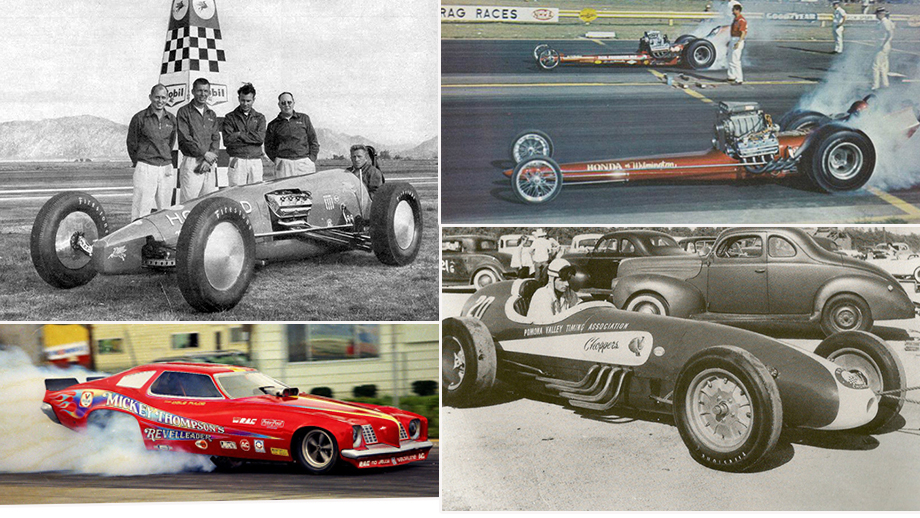
Revealing to you that I love old drag racing photos is probably on par with my telling you that I need oxygen to live. You probably already guessed this.
The wonderful thing about the internet — whether you’re scrolling past what your Facebook “friends” had for dinner or your significant other is searching Pinterest for humorous duck-themed doilies — is that there are tens of thousands of historic drag racing photos out there. You’ve seen thousands of them in this column alone over the last 19 years and 900-plus columns.
(Mea culpa: These photos are easily accessible but often uncredited to the talented photographers who captured them, which is a bit of a crime and makes me uncomfortable about exploiting them for my use, and I’ve often gone to great lengths to assign credit at least and permission at best.)
A few years ago, I wrote a pair of columns [here and here] about my “photo hoarding” fascination and found that not only am I not alone, but my “collection” pales in comparison to some of yours. Because I’ve seen so many photos over my four decades in the biz, it takes quite a bit for me to say “I gotta have that one” or otherwise decide to capture it.
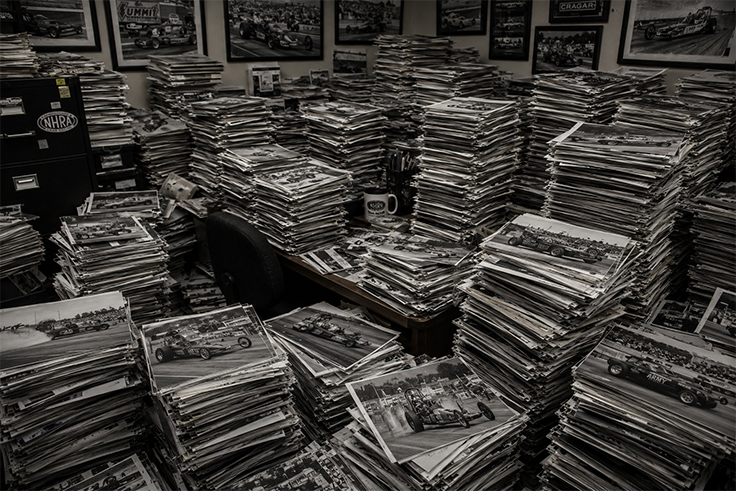
According to the experts, the key feature of hoarding anything usually isn’t the object itself — it’s the strong emotional attachment, fear of needing it later, or sentimental value. While I certainly don’t mean to make light of that actual condition, and ours certainly seems much less harmless, I find the same reasons to keep them.
Strong emotional attachment? Check. A lot of these photos feature people that I considered my family … that crazy uncle, the thoughtful grandfather, the mad scientist cousin. I care about people and, just like music can be the soundtrack of our lives, photos are certainly the scrapbook.
Fear of needing it later? Yep. This probably doesn’t figure into your decision, but for me, it’s sometimes, “Hey, if I ever do a feature on this guy, I’d like to have this photo handy.” More than one column has been fired to life because a photo struck a nerve.
Sentimental value? You betcha. Maybe it was a race you were at, and the photo captures that memory. Or maybe it’s a photo of one of your idols who has left us. Lotsa reasons.
The other part of the equation for me is seeing a photo and wanting to find out as much about it as I can, or reporting what I already know, thus hopefully fleshing out the picture for you.
With all that in mind, let’s see the latest treasures in my vault.
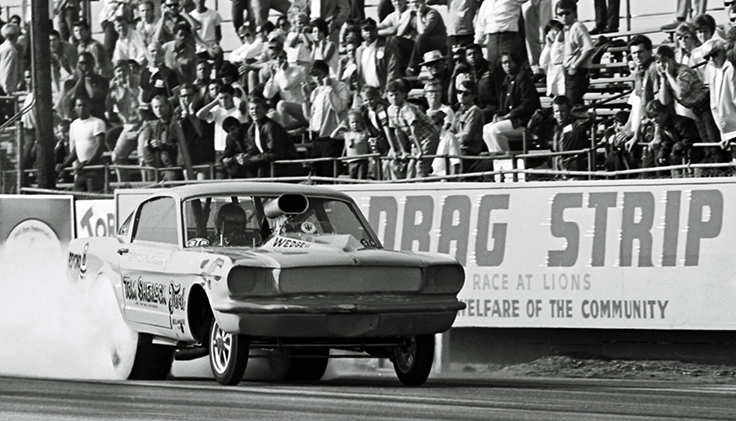
One of my greatest regrets is never going to Lions Drag Strip before it closed in December 1972. I had only been to my first drag race at Orange County International Raceway (OCIR) the previous year, and even though Lions was closer to our Culver City, Calif., base, my parents took me to OCIR.
Culver City plays into this photo as this wild supercharged Mustang, the Tom Sherlock Ford-sponsored, Larry Barker-driven Psycho of Ralph Snodgrass and Pat Mahnken, eventually ended up as my next-door neighbor, as I wrote about in detail here. Lions is as much the star here as the car; this photo shows the unparalleled close fan seating.
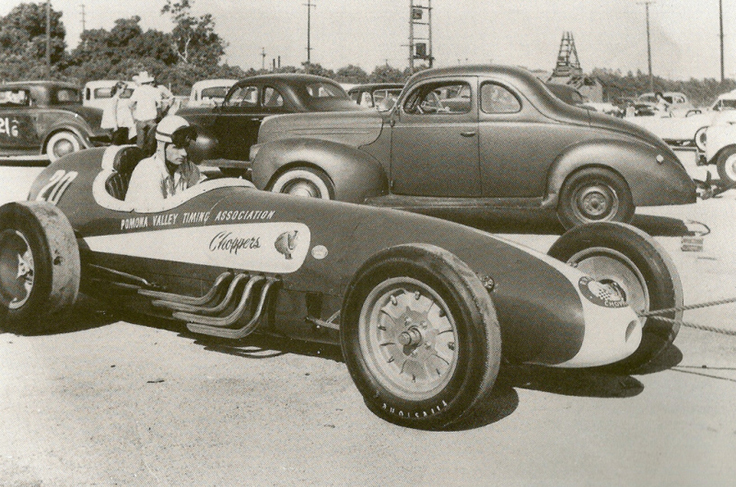
This is the club car for the Pomona Choppers that helped found the Pomona dragstrip with the help of Pomona Police Chief Ralph Parker. (According to local lore, the Choppers rebranded themselves as the Pomona Valley Timing Association (PVTA) because the group's accountant thought it would be a good idea if the organization was going to be working with civic officials, but both names are on this car.) This 331-cid Chrysler-powered car was campaigned in 1954 with drivers including PVTA mainstays Chuck Branham and Chuck Griffith behind the wheel. Less than a decade later, Branham, who did public relations and technical advisement for the PVTA and was also a regional technical director for the NHRA, would die as the result of burns suffered in a fire in the Starlite dragster at the Pomona track in January 1963.
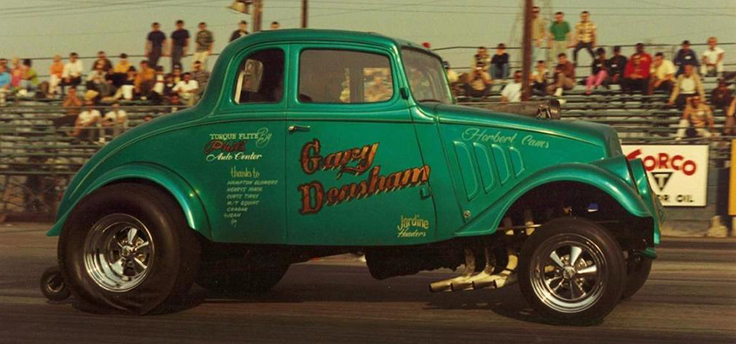
Long before he started a career that has made him the most-seasoned Funny Car racer in history, Gary Densham raced supercharged doorcars like this Willys, shown at Lions. Before this car, Densham had an Olds-powered ’40 Ford coupe and, with a decent job loading trucks, had the money to rent a shop that, fortunately for him, was in a racer-centric compound.
“We called them the caves,” he told me a few years ago. “They were 800 square feet; just four bare walls, a toilet, and one light bulb. But during that era, Steve Plueger was there; Steve Leach of RCD was there; Chuck Finders, who built all of those A/Gas Supercharged cars, was there; Ray Zeller was there. More than half of them were into racing. This was right in the heyday of the A/Gas Supercharged cars. We knew they were faster, but they were heavier and had the same size motor we did. The answer was simple, that pretty thing sitting on top of the motor: the supercharger.
“The first car I ever put a blower on was my chopped-top ’33 Willys. It was at Long Beach [Lion’s], in the fog, racing Willie Borsch. I stood on the gas, and it just scared the crap out of me. I was so scared I went from 1st gear to 4th, and when I got out at the other end, my legs were shaking so hard I could barely stand up. But it was magic.”
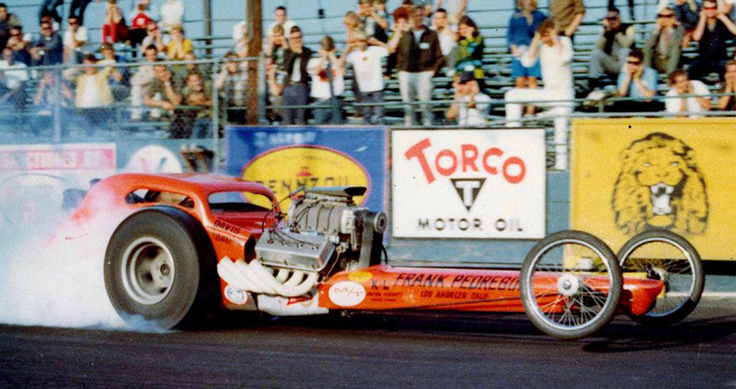
More Lions and more Funny Car lineage as “Flaming Frank” Pedregon — father of future flopper pilots Tony, Cruz, and Frank Jr. — puts his Fiat coupe/dragster through its paces at The Beach. The “Flaming” nickname came from when the coupe would actually light the rear tires on fire, either by design (some have said he’d pour gasoline on the tires) or because of excess fuel from the overly rich engine soaking the tires. The brothers recreated this car a few years ago for cackle purposes.
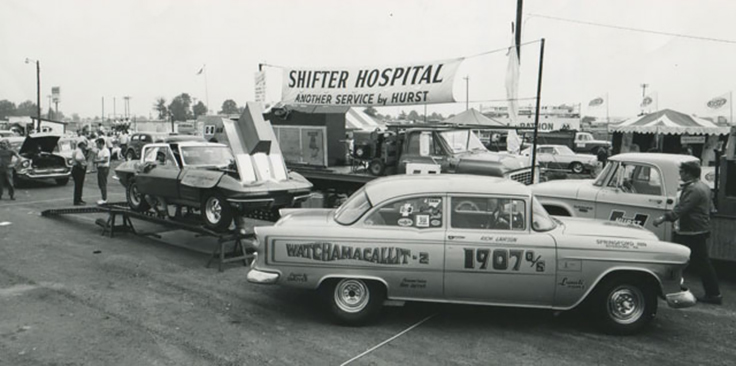
Anyone who attended an NHRA national event back in the 1960s and ‘70s certainly remembers this beehive of activity, the Hurst Shifter Hospital. Back then, a lot more race cars had manual transmissions and, being racers, they wore them out a good clip, which is where Hurst’s “Shifty Docs” were on duty to repair the “patients.”
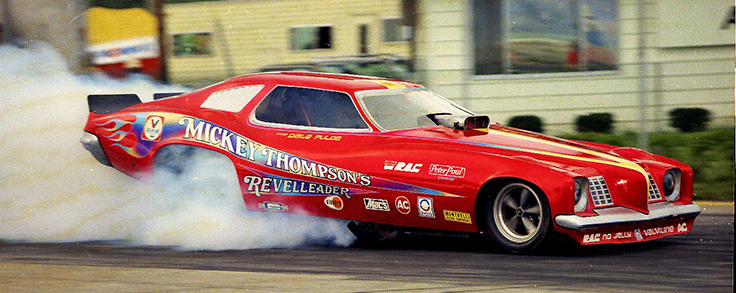
Ah, one of my all-time favorite Funny Cars in my all-time favorite paint scheme in this photo by the late, great Tom Schiltz. I devoted three full columns to my love of this car back in 2013 [here, here, and here] that started out yellow, then went black, then this gorgeous red scheme, and then into U.S. Marines livery.
Dale Pulde was the car’s original driver when it debuted (in primer) at Lions Last Drag Race in late 1972 but was inexplicably replaced for the 1973 season by Butch Maas, then got the ride back after Maas was badly burned in a fire at the NHRA Gatornationals. Pulde and his car had a hand in deciding the 1974 world championship, as it was he who defeated Don Prudhomme in the second round of the NHRA World Finals to secure the title for Shirl Greer. Pulde did it in impressive fashion with a national record blast of 6.16, 233.76 mph.
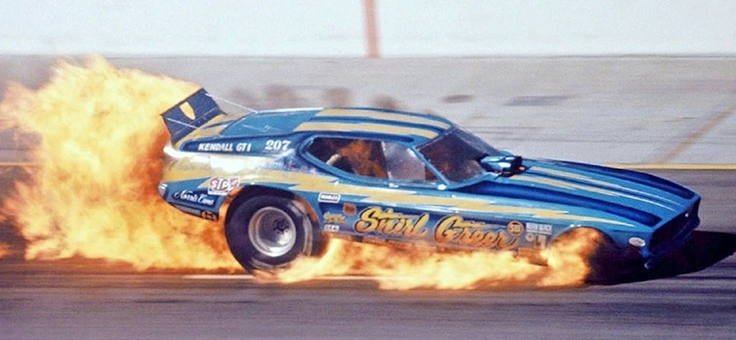
And speaking of Greer, here’s this scary (and rarely seen) photo of his qualifying fire that left him badly burned. You can clearly see the fire inside the cockpit that badly burned Greer’s hands. I wrote in detail about Greer’s courageous comeback — with a little help from his friends and even his championship rival Don Prudhomme — in this column.
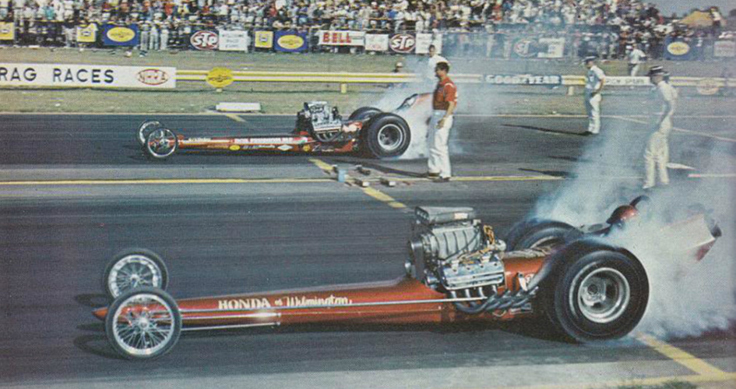
And speaking of “the Snake” (I’m the king of segues), here he is in the far lane in the Top Fuel final at the 1966 NHRA Nationals in Indy en route to losing to Danny Ongais and the Honda of Wilmington Mangler (despite most people calling the track “Long Beach” or simply “the Beach,” Wilmington was the actual town in which famed Lions Drag Strip was located).
This was Prudhomme’s first year out on his own after leaving good pal Roland Leong and the 1965 Indy-winning Hawaiian to field the B&M Torkmaster car with backing from the Spar brothers. Although Ongais won Monday's final round, 7.46 to 7.60, he didn’t win the Nationals because at that time, Monday’s winner still had to race Sunday’s AA/FD class winner for overall honors. Mike Sniveley, Prudhomme’s 1966 replacement in the Hawaiian, had beaten Nick Marshall in Sunday’s class final, then sat out all day and returned to beat Ongais, who red-lighted.
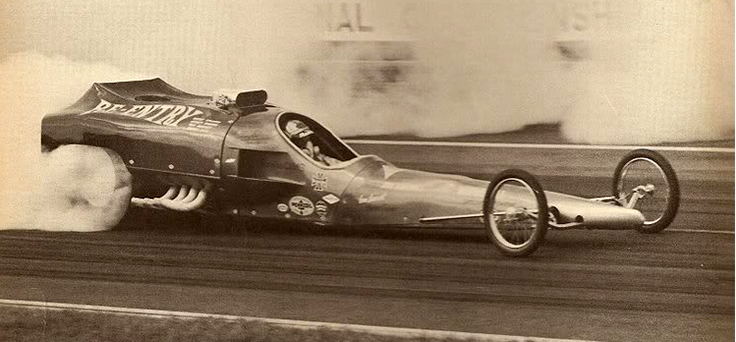
That same year in Indy, Robert Lindwald was piloting a wild, streamlined rear-engine dragster called Re-Entry. Remember, this is more than four years before Don Garlits’ famed Swamp Rat 14 revolutionized the class in 1971, but Lindwall’s wild car, the design of which was reportedly inspired by his hydroplane boat-racing experience, reportedly was the first rear-engine car to top 200 mph earlier that year. His Indy ’66 experience did not end well. After defeating red-lighting Tom Hoover in round one of the AAFD class, he crashed in the shutdown area after a losing 201.34-mph loss to Connie Kalitta in round two, and the car was never rebuilt.
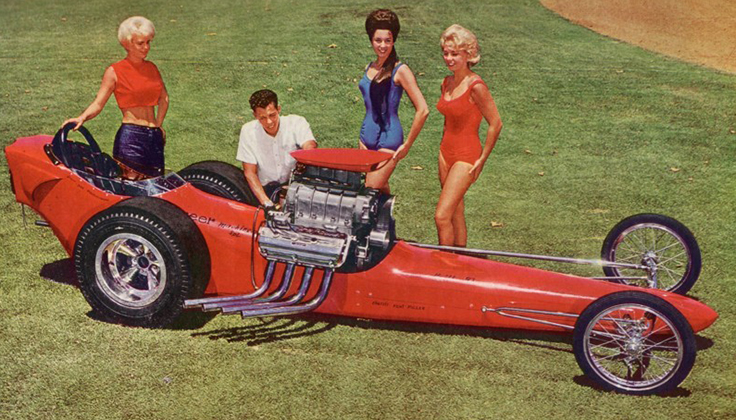
And here’s the pre-“Snake” Prudhomme and friends with the freshly-out-of-the-paint-shop Greer-Black-Prudhomme Top Fueler that would bring him great acclaim. The G-B-P dragster was the terror of the Southern California Top Fuel wars from its victory in its June 1962 debut at Pomona Raceway through the end of the 1964 season. While a famous Schiefer Clutch advertisement claimed that Prudhomme racked up a stunning 236-7 win-loss record in that time, the real number is closer to 81-8, still an impressive number. Also, according to records I found online, that car was not red (as often reported), but “Buick Naples Orange.”
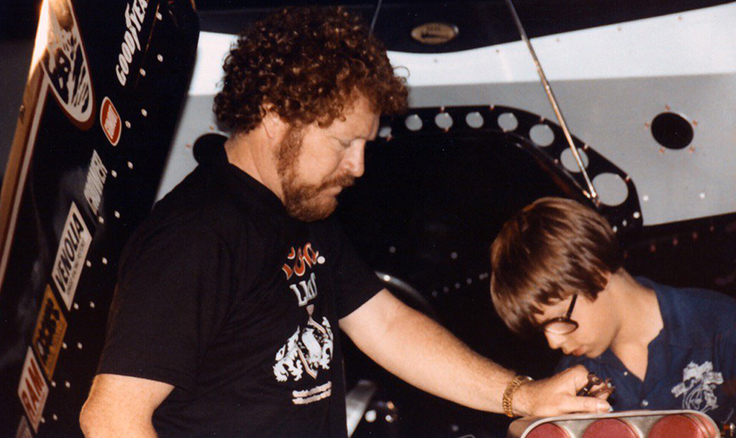
Every great “Snake” photo deserves a “Mongoose” rebuttal, so here’s the famous “Mongoose,” Tom McEwen, overseeing the work of a very young crewmember who would go on to great tuning fame. Yes, race fans, that’s teenage Jimmy Prock working on “the ‘Goose’s” flopper. I asked Prock about this in Charlotte, and he says that he started working on nitro cars in his early teens and never wanted to do anything else.
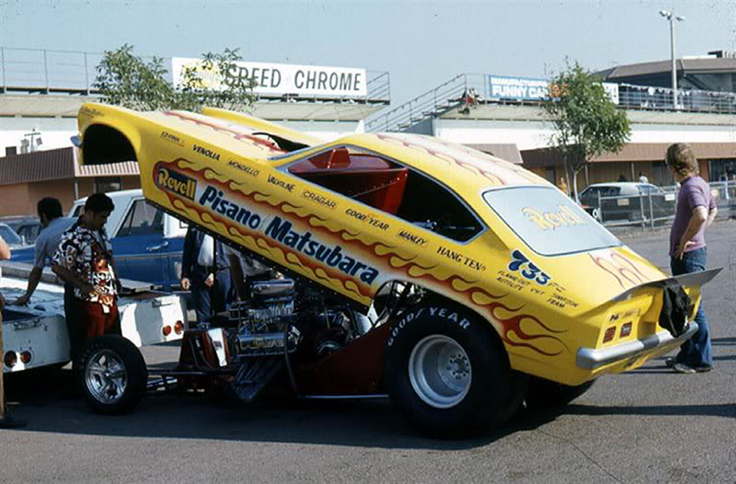
Man, does this bring back some memories for me. Not only is this taken in the pits at Orange County International Raceway (that’s a line of racer-oriented stores beneath the grandstands with the roof of the famed Champion tower visible at top right), but the Pisano and Matsubara Vega (car owner Joe Pisano and driver Sush Matsubara) was the first Revell drag racing model I ever built as a kid. This is probably 1973.
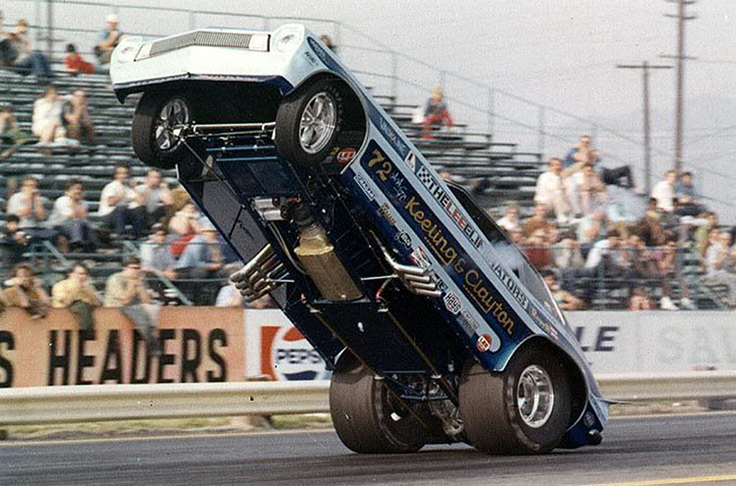
John Keeling and Jerry Clayton fielded some of SoCal’s prettiest cars in the 1970s, beginning with their legendary California Charger Top Fueler and later a series of Funny Cars, including this Pinto shown going wheels way up at Irwindale. Keeling was an aircraft ground mechanic and Clayton a jumbo jet pilot, so they had appeared to have the right funds, but when they put dragster driver Rick Ramsey — fresh off his win at the 1970 NHRA Supernationals — in their first Funny Car, they had to share the engine from the Top Fueler, which made too much power for the Funny Car. I’m not sure if this is Ramsey proving that point; I think more likely it’s Tom Ferraro, who then was succeeded in various K&C cars by Dale Pulde, Jake Johnston, Pat Foster, and, finally, Neil Leffler, who drove the team’s last car, a ’77 Trans Am that Cruz Pedregon recreated as a Nostalgia Funny Car.
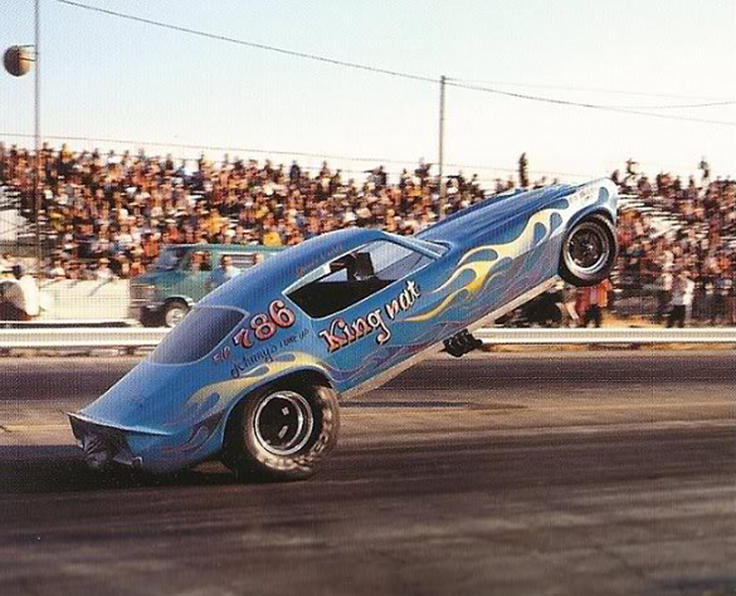
I guess you could say that the ‘Dale had good traction, as Gervase O'Neill also aired out his King Rat Camaro. O’Neill and crew chief/brother Johnny were Chevy guys through and through, fielding not just Chevy-bodied but Chevy-powered floppers into the late 1970s.
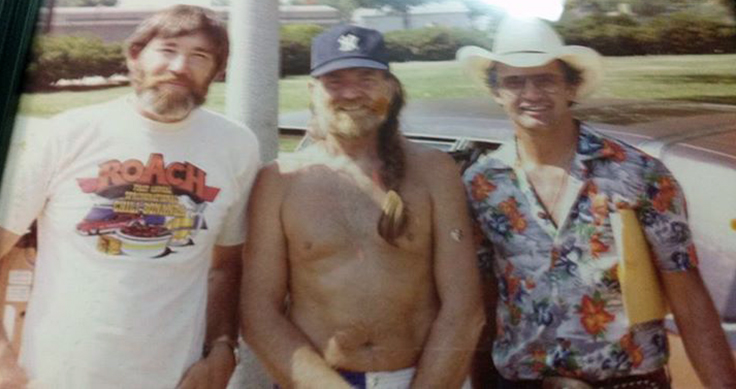
Here’s a trio to draw to, with great NHRA National Dragster photographer Leslie Lovett, left, and “King Richard” Tharp flanking legendary artist Willie Nelson. In addition to being one helluva Top Fuel driver, Tharp was the master of night clubbing and was friends with Nelson, Waylon Jennings, and even Dallas Cowboys bad boy Thomas "Hollywood" Henderson, as I wrote about in one of my favorite columns about Tharp: 'King Richard': Damndest Thing You Ever Saw, the second part of the title coming from the famous business card he used to hand out.
Tharp told me this week that this photo was taken at a celebrity softball game that Waylon and Willie and the boys were hosting before a Hollywood Bowl performance in the late 1970s, a concert that was around the same time as the NHRA World Finals in Ontario, Calif. Lovett was a huge Willie Nelson fan, and Tharp invited him to the game to shoot photos.
“He was in heaven,” Tharp laughed at that memory. “He must have taken 500 photos.”
According to Tharp, this was the same concert that he famously got in a little over his head, promising backstage passes, as he shared with me in that column.
“It was about the same time as the World Finals, so everyone was coming to me for tickets, and I had like 38 people asking me for backstage passes,” Tharp recalled. “I had no idea how I was going to come through, but I went in there and said, ‘Willie, I need 38 backstage passes.’ He said, ‘What for?’ And I told him, ‘Well, I told all these people I’d get them in.’ He said, ‘Well, you go out there and tell them the truth: Tell them you lied.’ He’s really a funny guy, a great guy.”
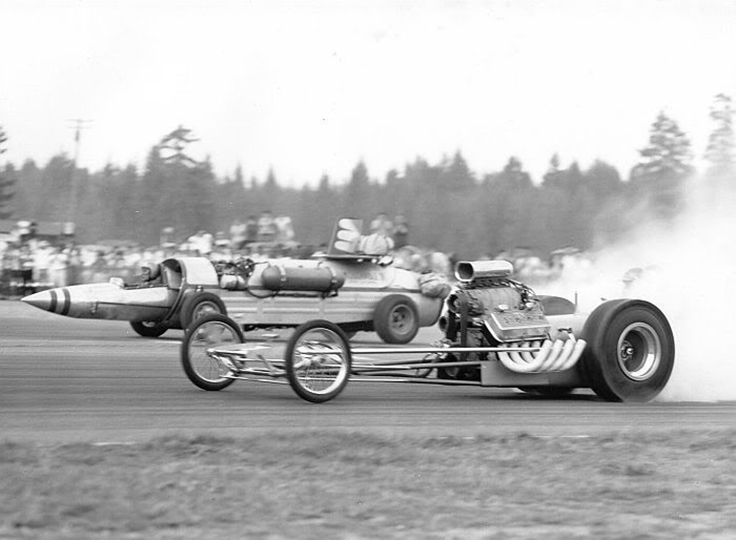
Speaking of kings (there I go again), the “King of the Northwest,” Jerry Ruth, could take on all comers, and that included the occasional jet car, as he’s shown racing Romeo Palimides’ Untouchables jet dragster in Seattle in the mid-1960s.
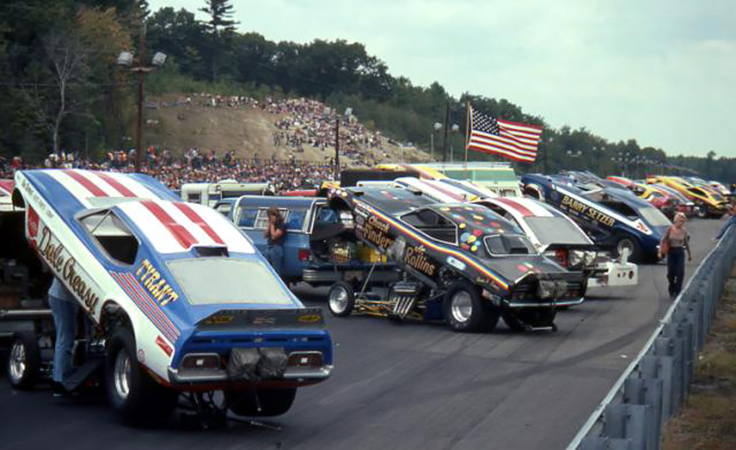
New England Dragway, home of the NHRA New England Nationals, has hosted big Funny Car shows for decades. Based on the visible cars, including Dale Creasy Sr.’s Tyrant Mustang, Bruce Larson’s USA-1 Monza, former AA/GS driver Chuck Finders’ 'Cuda (the ex-Bob Larimore Circus 'Cuda), and the blue Barry Setzer Vega (driven for years by Tommy Grove), I think this is 1976.
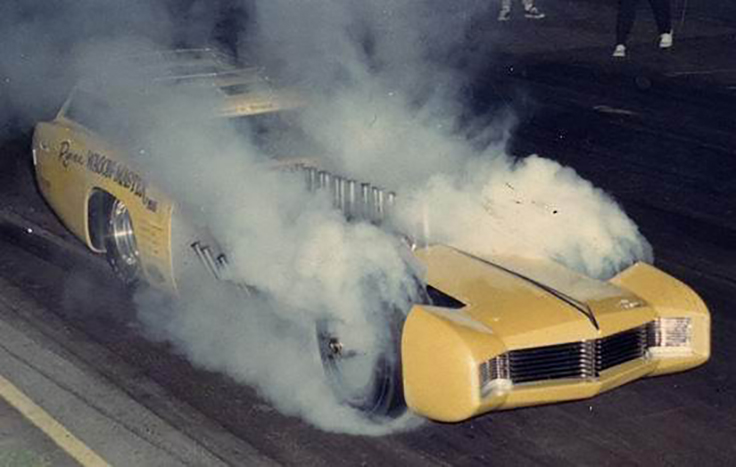
Tommy Ivo’s amazing Showboat dragster — powered by four Buick engines and four-wheel drive — was popular from the get-go when it debuted in 1961. Although it wasn’t fast, the image of all four slicks churning up white smoke was not to be forgotten. Don Prudhomme initially drove it (Ivo’s contract with the studio and his starring role in the Margie television show precluded his driving), then Tom McCourry briefly drove it before Ron Pellegrini became the main driver for the schedule-packed 1961, 1962, and 1963 seasons, highlighted by an appearance at the 1961 Nationals in Indy.
McCourry bought the car and ran it for two years in 1964 and 1965, then, with the popularity of Funny Cars on the rise, decided to put a Buick station wagon body (albeit with a Buick Rivera hood, front grille, and bumper). George Barris designed this body that Tom Hanna formed from sheets of aluminum and added modified original Buick chrome trim. The result was the car pictured here, rebranded as The Wagon Master.
Ivo eventually reclaimed the car and ran it briefly during his 1982 retirement tour. At his third stop, and after just a dozen passes, he crushed three vertebrae in his back after running over a frost heave under the track in Saskatoon, Sask. Funny Car driver Rick Johnson drove the car the rest of the year. Ivo climbed back into the car at the 1982 World Finals at Orange County Int’l Raceway, stuffed about a dozen pillows into the cockpit to cushion him, and made his final pass. He drove the car back to the starting line, jumped on top of the car, took a pair of BBQ tongs, and set alight his driving gloves with one of the portable propane track driers.
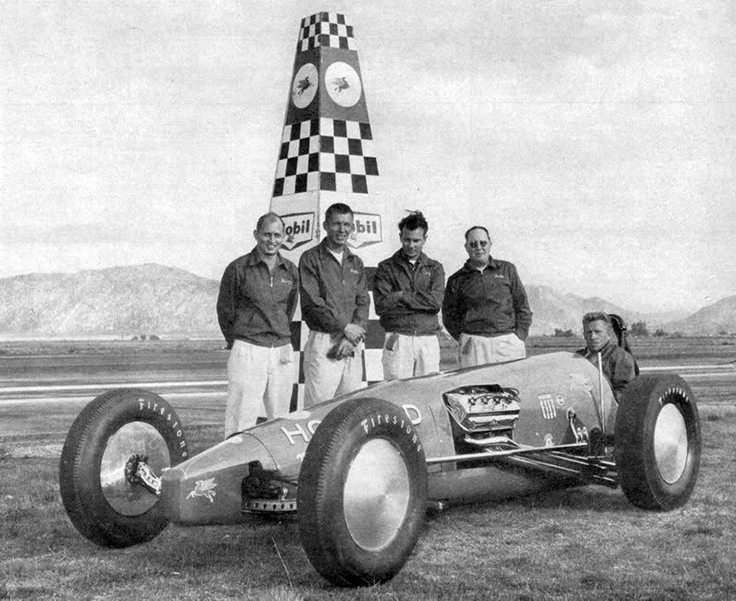
And finally, this great piece of NHRA history. In 1957, NHRA President Wally Parks, in what he called the chance "to prove that where there are hot rodders, there is know-how," set out to have drag racers lay claim to FIA world records for fastest-standing kilometer and fastest kilometer speed and recruited 1955 Nationals champ Calvin Rice and fellow dragster driver Ed Cortopassi to prove the point.
The Class B standing-start kilometer records were 19.08 seconds at 117.3 mph, while the Class C record was 21.20 seconds and 105.5 mph. Both were set in 1937 by German Bernd Rosemeyer on the Frankfurt-Darmstedt Autobahn.
Parks and the Hot Rod team first set out to capture the World Unlimited and international Class B records (the latter for 305 to 488 cubic-inch engines, for which Rice's 342-inch supercharged Chrysler was eligible). Because Rice had bombed down the Riverside Raceway half-mile the previous October in just 16.88 seconds, hopes were high he would break the B mark easily.
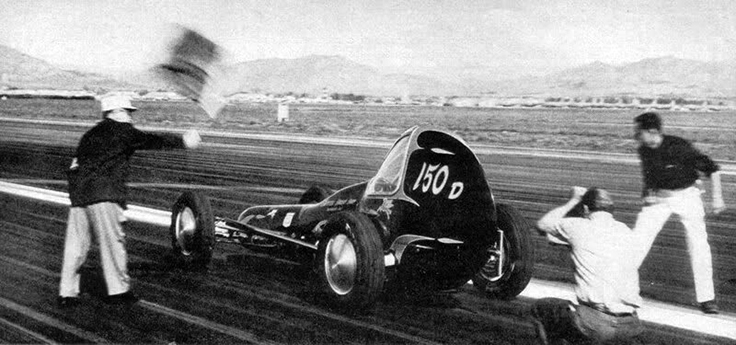
They also decided that the Class C (183 to 305 cubic inches) was also reachable, so Cortopassi's aerodynamic "Glass Slipper," with its 301-inch Chevy powerplant, was enlisted. The Slipper, with its canopied cockpit, had exceeded 180 at Bonneville and 160 in the quarter-mile.
They assembled in February 1958 at March Air Force Base, on the outskirts of Riverside, Calif., and handily smashed the records. On the first leg, Rice ran 124.731 speed, backed up by a 122.403 to reset the record at 123.556. Rice's elapsed time average of 18.045 bettered the German mark by more than a second.
Cortopassi toppled the Class C International Record, turning the standing kilometer in 19.213 seconds at an average speed of 116.428 mph.
You can read the complete account here in the National Dragster archives.
OK, race fans, that’s it for the week. I hope you enjoyed this trip back down memory lane, and maybe I gave you a few extra photos and info for your collection. Thanks for reading.
Phil Burgess can be reached at pburgess@nhra.com
Hundreds of more articles like this can be found in the DRAGSTER INSIDER COLUMN ARCHIVE
Or try the Random Dragster Insider story generator