

The early Hart of the NHRA
Don Garlits and Darrell Gwynn; their lives in words and photos in new books

Random ramblings and rumblings, the sequel
Random ramblings and rumblings
Memories of Englishtown
-
Remembering Steve Ambrose
Right back where we started from: Winternationals is back at No. 1
Meet Larry Wood: The man whose designs launched a million hot rod dreams
Can you imagine a toymaker designing your Top Fueler? 'Snake' and 'Mongoose' could
For the love of old drag racing photos
The ultimate Funny Car winners quiz
Still popular after all these years: Catching up with fan favorites Eddie and Ercie Hill
Eddie Hill, the early years
55 years ago, Don Garlits forever changed the look, feel, and future of Top Fuel racing
On a roll: A look at some all-time great NHRA Drag Racing success streaks
- ad
NHRA's Top 75 Moments: Bernstein, 'Big,' and Shirley reflect on making history
Funny Car set to turn 1,000: A look back at the milestone races along the way
Beyond the Top 75s ...
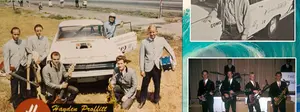
Wait ... Jim Head was in a 1960s surf band promoted by a drag racing legend? Yep.
More Martin memories
The Popular Hot Rodding Championships put U.S. 131 in the national spotlight
Friends we lost in 2025
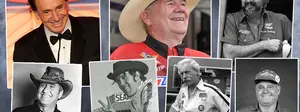
Re-telling NHRA history: The 75th anniversary book and other special projects
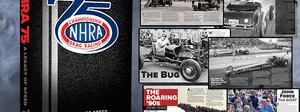
It was John Force's world, and we were all thrilled to be living in it
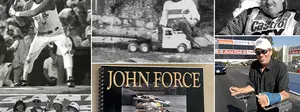
The Joyce of Drag Racing Photography
- ad
Two legends: 'Big' and Bakersfield
When did we start doing that? Tracking some of the biggest changes in our sport
From 10-time dominators to one-time winners, a history of Indy Top Fuel champs
Legend to legend: Don Prudhomme on Don Garlits, Indy, and other great takes
NHRA Rookies of the Year: A look back at where some fabulous careers began
How the early 1980s shaped NHRA's future
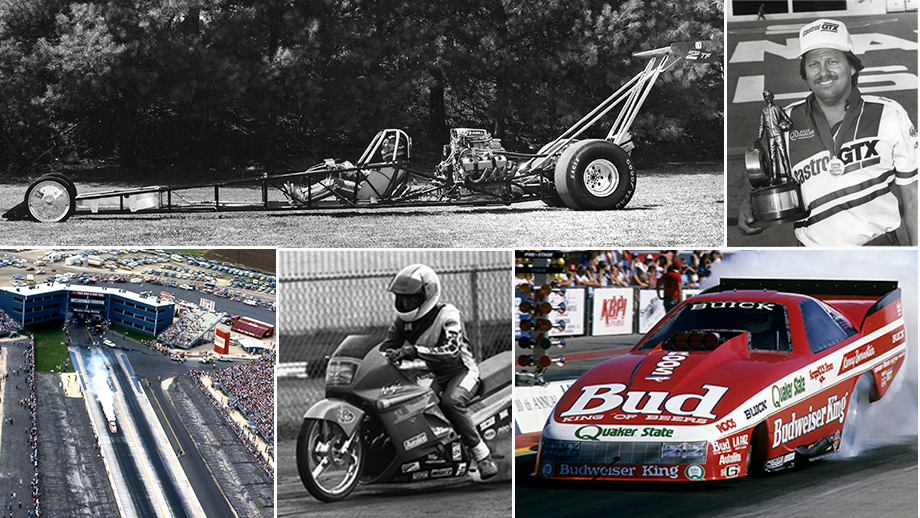
The old adages say, "The first five years lay the foundation for the next 50" and "Every great career begins with five gritty, hungry, curious years."
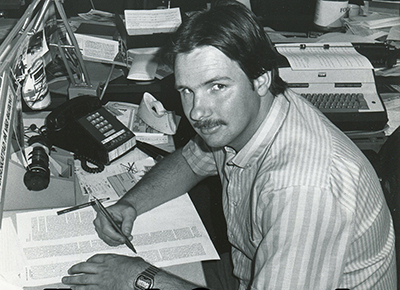
When I look back at my time at NHRA — just starting my 44th year — I sometimes think back to my first five years here and couldn’t agree more with those sentiments. From my arrival in mid-May 1982 through the end of the 1987 season, I still marvel at all the things that happened in that short span that would greatly influence the years that followed.
Joe Amato and Tim Richards forever changed the profile of Top Fuel, Kenny Bernstein and Dale Armstrong changed the face of Funny Car, NHRA reinvented Pro Stock and officially welcomed Pro Stock Motorcycle. Don Garlits made a celebrated comeback and then retired again. Austin Coil became a household name, and John Force became a winner. We lost the great Lee Shepherd and almost lost Shirley Muldowney. Don Pruchomme had to sit out a season with no sponsor, then came back with a vengeance, and new "stadium-style" tracks like the Texas Motorplex helped reshape the fan experience.
Below are my recollections of those great years, along with links to how NHRA National Dragster covered them (plus links to my older Insider articles). Enjoy this walk down a history-making Memory Lane.
::: 1982 :::
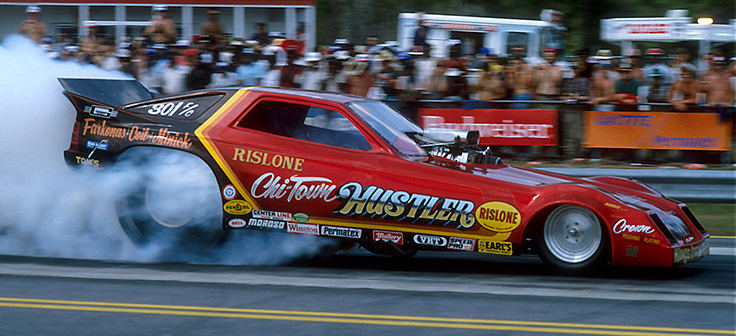
When I checked in for my first day of work at National Dragster on May 24, 1982, the Chi-Town Hustler was already the big story of the year. Known for years as primarily a match-race specialist, The Hustler shockingly qualified No. 1 and reached the semifinals at the NHRA Winternationals, then won the NHRA Gatornationals.
People knew Austin Coil if for no other reason than the car had always been sub-dubbed Farkonas-Coil-Minick (for co-owner John Farkonas and original driver Pat Minick), but 1982 began to show what we all know today: Austin Coil is a bad-ass tuner. Incredibly, they won the world championship that year and the next as well. Even though he’d been driving the Hustler since 1980, no one really knew who Frank Hawley was or what he would become, and the story of their meeting, as I wrote here, is a funny one.
The 1982 Winternationals also marked the debut of the 500-cid/2,350-pound era in Pro Stock as NHRA dispensed with its often-controversial and ever-shifting weight break formula. That change came 12 years after the class’ debut, and it would largely go unchanged for more than 33 years until electronic fuel injection replaced carburetors in 2016.
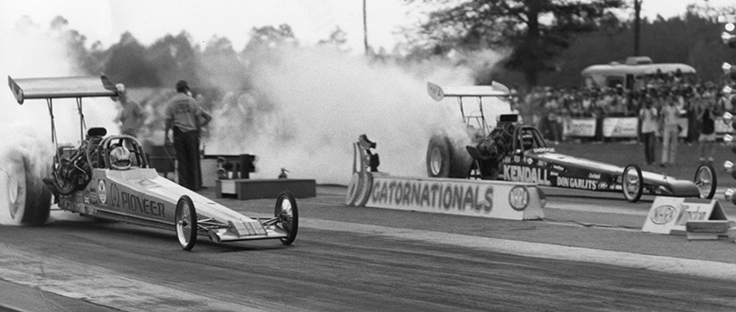
The Gatornationals had also produced a memorable Top Fuel final between Shirley Muldowney and Don Garlits. Garlits had started the season with his radical Swamp Rat 27 sidewinder dragster at a match race at Orange County International Raceway, where Muldowney whipped him, then did the same thing when “Big” reverted to his conventional car in Gainesville.
Also in the months before I came onboard, Lucille Lee had shocked everyone by first driving Marc Danekas’ TR-3 Special to victory at the March Meet, defeating Muldowney in the final, and then followed a month later by winning the NHRA Southern Nationals, becoming just the first woman (after Muldowney, of course) to win an NHRA Top Fuel race. Those facts did not sit well with Muldowney, who had lost in round one in Atlanta (to Connie Kalitta, of all people), and two events later, she trounced Lee in the final of the NHRA Springnationals.
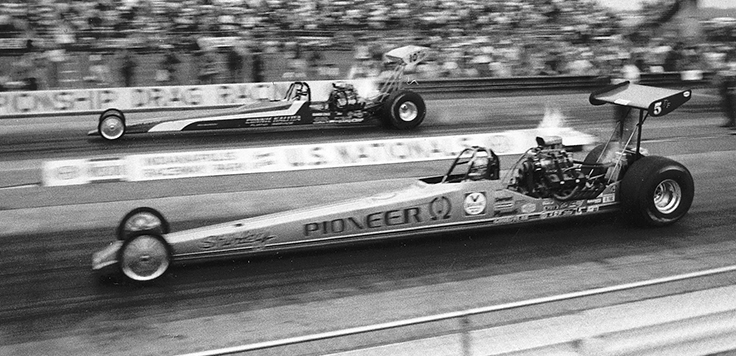
En route to her third and final world championship, Muldowney drove the revenge dagger in even deeper by beating Kalitta in the final round of the NHRA U.S. Nationals for her first and only Indy win. Despite that, it was also a good year for Kalitta, too, who earlier that summer had won Le Grandnational, his first Top Fuel win since the 1967 Winternationals, beating Muldowney in the final.
The NHRA Cajun Nationals, the bridge event between the Southern Nationals and Springnationals, was where Don Prudhomme made the first 250-mph Funny Car pass.
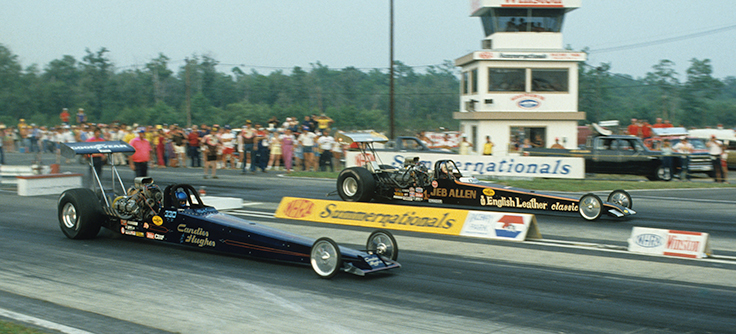
Performance barriers were being broken left and right, and it was at the 1982 NHRA Summernationals that Mark Oswald, behind the wheel of the Candies & Hughes dragster, finally broke Garlits’ seven-year-old 5.63 national record, which had been set at the 1975 NHRA World Finals. Oswald went on to win the event over Jeb Allen.
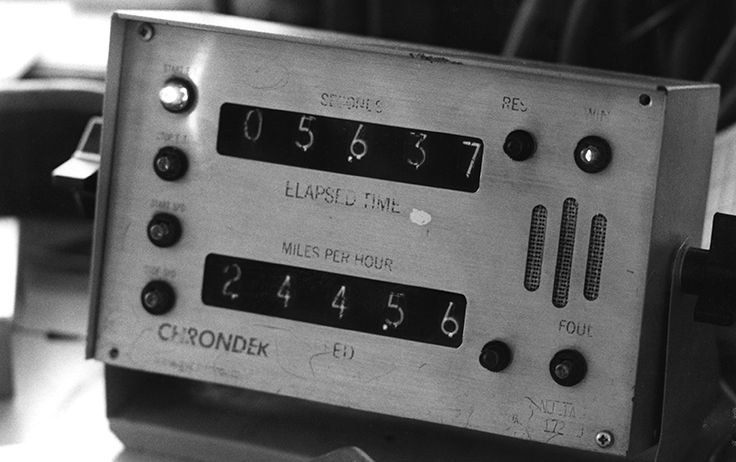
The 1982 U.S. Nationals was the site of Prudhomme’s mind-bending 5.63 Funny Car run at a race where rumors of nitrous oxide pervaded, and for Gary Beck’s 5.48, the first sub-5.5-second run in Top Fuel history. Of course, I was still the new kid on the block, and the budget did not allow me to attend the event, but it was the last U.S. Nationals that I would not attend.
The U.S. Nationals also played host to the first Big Bud Shootout (won by Hawley over Prudhomme) that set the trend for specialty events that continues today through all four classes with the Callout races.
::: 1983 :::
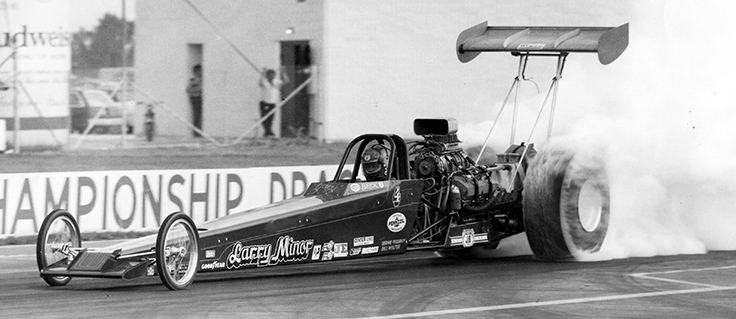
Beck’s 5.48 was just the tip of the performance iceberg. In 1983, his Larry Minor-owned dragster scored four wins — including the U.S. Nationals — and made 16 of the season's 17 quickest passes en route to the Top Fuel championship. The team first reset the national record 5.44 in Gainesville, then ran 5.42 in Atlanta and dual 5.39s at the season’s final two events. The one race that Beck did not win was the Cajun Nationals, where Minor was in the other lane in the final and was planning to let Beck win, but Beck lost his blower belt, and Minor couldn’t get his car slowed in time.
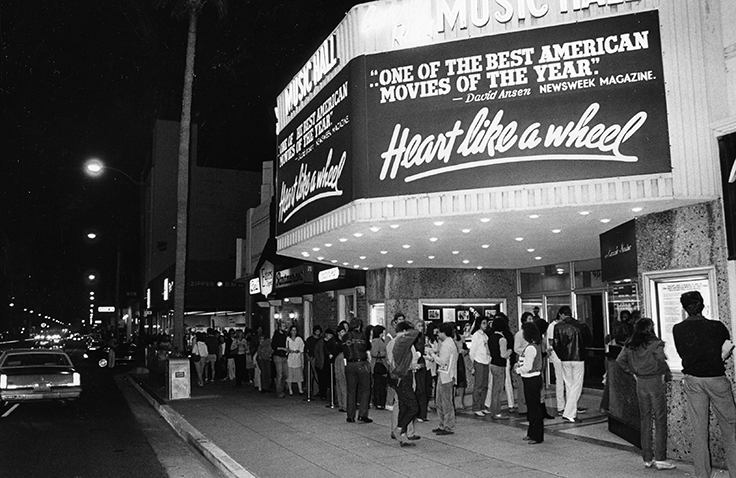
Although Muldowney didn’t win the championship again, she was in the spotlight anyway with the release of the Hollywood biopic Heart Like A Wheel, which was met with critical acclaim in its full release the following year.
Joe Amato officially arrived on the Top Fuel scene, winning his first in the class at Le Grandnational in Canada, and Mark Oswald won his first in Funny Car, setting up what would be great 1984 seasons for both.
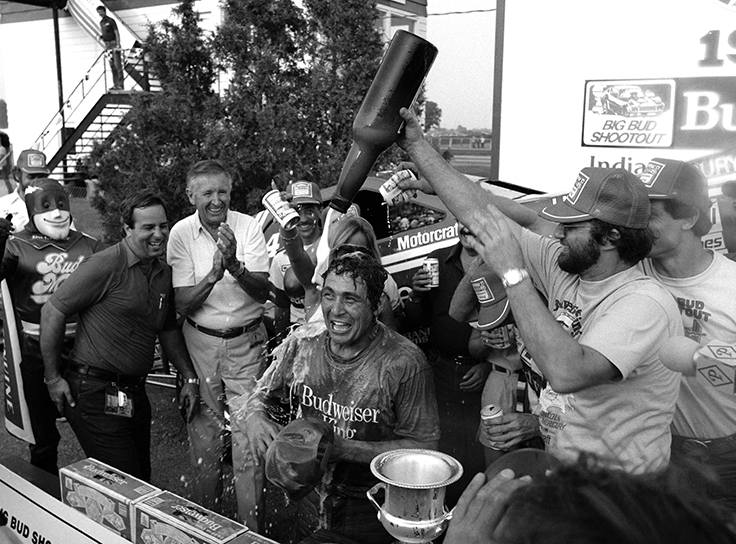
Kenny Bernstein swept U.S. Nationals Funny Car honors, winning his sponsor’s Big Bud Shootout on Sunday and “the Big Go” on Monday. Oswald, meanwhile, drove the Candies & Hughes Funny Car to a 257.87-mph pass during eliminations that was faster than the fastest Top Fuel speed. The Indy Funny Car field was also the first five-second 16-car show.
The U.S. Nationals also marked the christening of the new Wally Parks Tower, which stood until last January. Meanwhile, the owners of Old Bridge Township Raceway Park in Englishtown had to construct a 25-foot-high brick wall that spanned the entire length of the tower-side bleachers and the staging lanes to curtail the track's noise problem. It worked for 35 years until the track shut down in 2018.
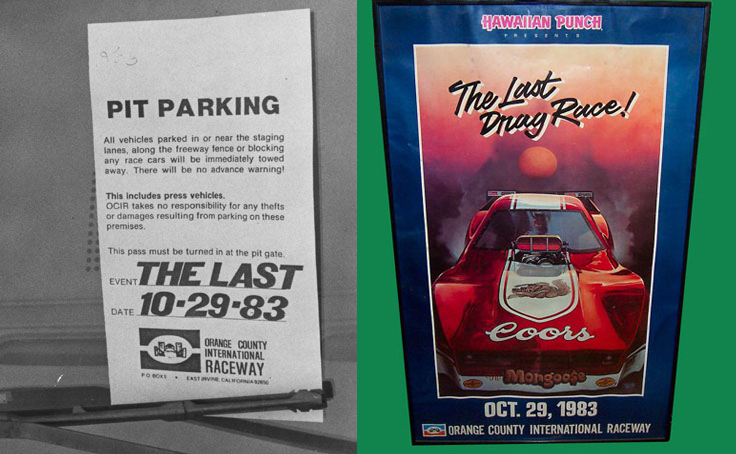
The year closed on a major bummer for me and tens of thousands of Southern California race fans as Orange County International Raceway closed its doors after The Last Drag Race on Oct. 29.
::: 1984 :::
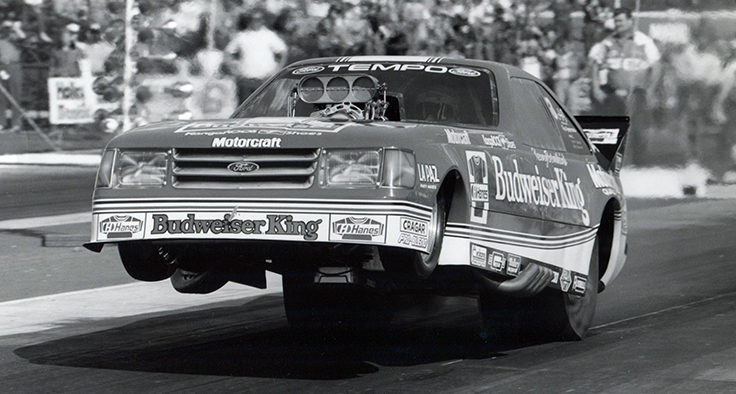
Nitro racing went aero crazy in 1984. Kenny Bernstein and crew chief Dale Armstrong raised the aerodynamic bar in Funny Car when he debuted a swoopy, new Budweiser King Ford Tempo that included rounded edges, full side windows, a belly pan and other aerodynamic aids, and an advanced data recorder, all of which laid the groundwork for today’s cars.
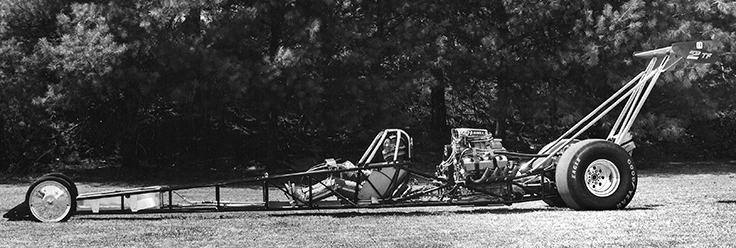
Similarly, just two months later at the Gatornationals, Joe Amato and crew chief Tim Richards debuted a revolutionary aerodynamic design on their Top Fuel dragster: a tall, laid-back rear wing mounted higher and farther aft than any previous model that lowered drag and increased downforce. The wing immediately paid dividends as Amato twice broke the 260-mph barrier and won the event, signaling a new era in Top Fuel aerodynamics with a design that remains a staple in the class.
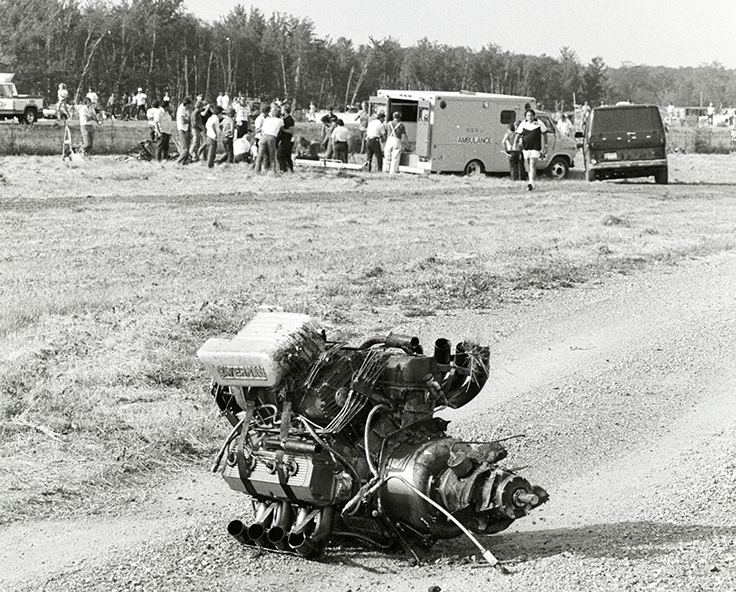
All was not well with Top Fuel that year, though. Likable California Doug Kerhulas was seriously injured in a sand trap incident at the Springnationals, and three weeks later, the heartbeat of NHRA was jolted when Muldowney suffered one of the most terrifying crashes in Top Fuel history at Le Grandnational when an errant inner tube from her front tire violently wrapped around the steering linkage, sending her dragster off track and into a drainage ditch, where it disintegrated.
I was there, standing on the starting line talking to, as I remember it, Gary Beck, and seeing her car turn hard left and disappear from view, and then seeing parts flying through the air and the engine screaming at high-C despite having left the chassis. Those were some dark days, and a lot of people thought Top Fuel was headed towards extinction, and IHRA even dropped the class completely.
Then “Big Daddy” rode to the rescue. Earlier that year, in our staff’s first trip to newly built OCIR replacement Firebird International Raceway for its preseason event, we’d seen Garlits trounced by Muldowney in a match race. Garlits was still wheeling his four-year-old Swamp Rat 26, and the car and trailer were literally covered in dust. To many, it looked like his glory days were finally gone, too. Little did we know.
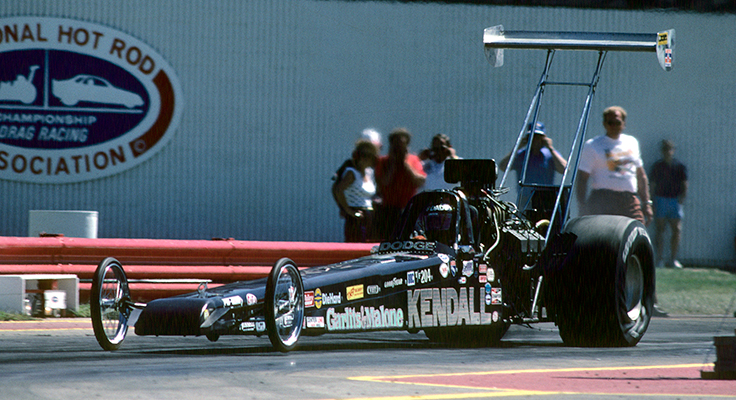
When we heard that Art Malone had convinced “Big” to run Indy that year, we all kind of scoffed at the thought. He hadn’t won Indy since 1978, but he and his self-described crew of “dinosaurs” whipped everyone, leading to a revolution of interest in the class and, ultimately, the world championships for him in 1985 and 1986.
If not for Garlits’ Indy heroics, a lot more people would remember what Jim Head did to win Funny Car at that same race, defeating the heavily backed beer cars of Ed McCulloch (Miller), Tom McEwen (Coors), and Kenny Bernstein (Budweiser) with a slow but steady barrage of 5.90s, which led to one of the most regrettably punny headlines in National Dragster history: “Head’s 5.90s hops leave beer cars flat.”
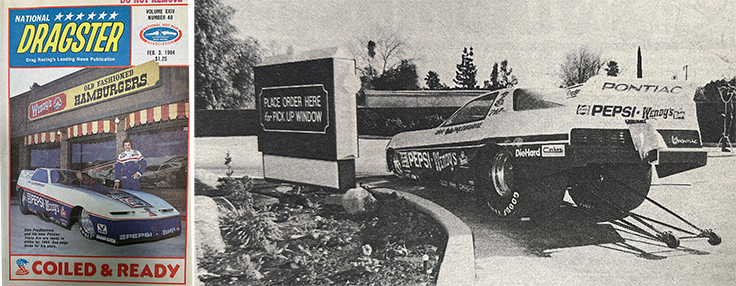
After three years with Pepsi backing, Don Prudhomme added Wendy’s to the side of his Firebird. I remember we asked to do a photo shoot with him with the car in the drive-thru lane at a nearby Wendy’s. He was very against the idea — I think his exact words were something like “I’m not doing that hokey-ass bulls**t” — but he relented because Leslie Lovett asked him to, and we got a great cover, albeit with the concession that the drive-thru image not be the cover but featured inside, as you can see above.
The accidents of Muldowney and Kerhulas and the accelerating costs of nitro racing led NHRA to briefly consider reducing the dragstrip to 1,000 feet, a real challenge for Dallas Gardner, who had assumed the presidency of NHRA earlier that year, replacing Wally Parks, who had held the position since 1963. I remember seeing some parody buttons in Indy that year proclaiming next year’s event as “The Indy 1,000” (a play on the Indy 500), but NHRA ultimately decided to retain the quarter-mile, which remained the standard until mid-2008.
::: 1985 :::
Garlits’ road back to the top in Top Fuel took a detour at Firebird’s next preseason event when the rear wing struts failed as he won his third straight race against Gary Beck, and the car crashed at the top end, fortunately into a mud bed. The car was not heavily damaged, and he repaired it in time for the Winternationals. Teams were still figuring out the right size for wing struts following the Amato evolution.
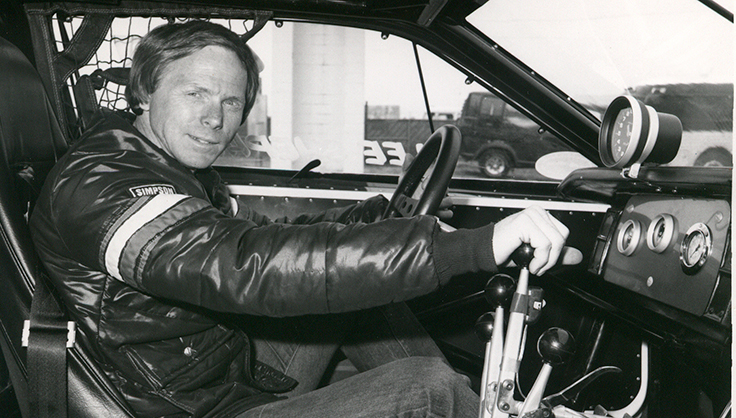
The year took a dark turn on March 11 when four-time and defending Winston Pro Stock champion Lee Shepherd was killed in a testing accident before the Gatornationals at Oklahoma's Ardmore Raceway. I distinctly remember receiving some inquiring phone calls and fellow staffer Chris Martin and I lecturing staff newcomer Jeff Morton about how bad rumors like those could get when Dallas Gardner walked into our office after overhearing our discussion and said simply, “It’s true.” We were gutted.
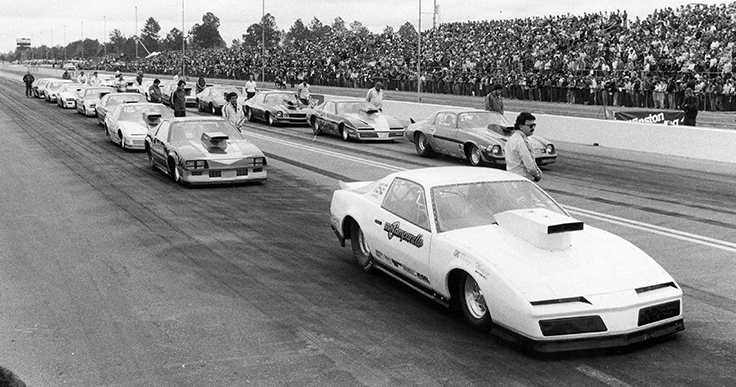
There wasn’t a dry eye in the house when Shepherd's fellow Pro Stock drivers honored him during the Gatornationals pre-race ceremony by driving down the track in the "missing man" formation, with an empty spot at the pole position alongside Don Campanello noting Shepherd's absence from that usual position. Bruce Allen took over Shepherd’s seat in the Reher-Morrison entry and won two races later that year.
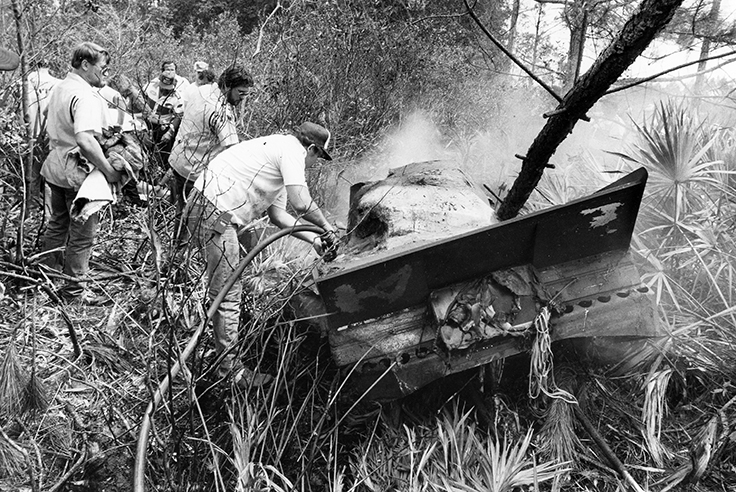
That year’s Gatornationals was also memorable for the trials and tribulations of Bob Gottschalk. The Top Alcohol Funny Car standout, who died last week, switched to nitro with disastrous results. In early qualifying, his engine dropped a header to the pavement, which scraped along and started a small brush fire in the area beyond the left guardwall at the top end. The NHRA Safety Safari quickly extinguished it, and we all had a little laugh. Gottschalk finished the job on a subsequent pass when his Camaro bombed the blower in the lights and caught fire. He lost control and slid into the woods along the shutdown area, his car trapped between trees, sparking a blaze that burned for hours.
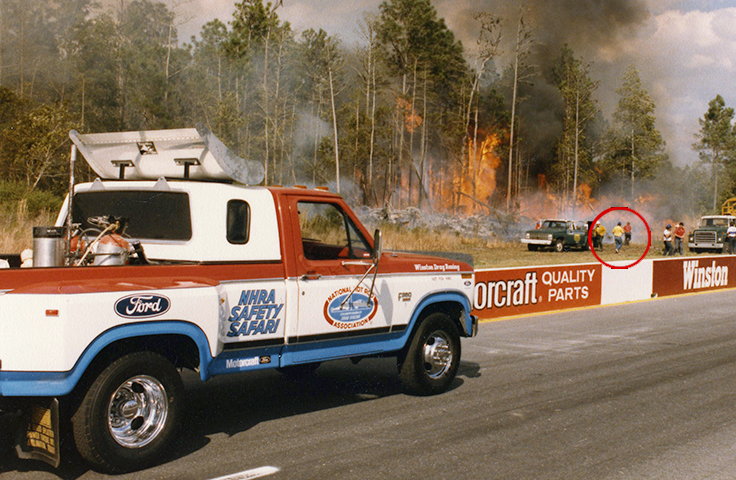
The Safety Safari rushed in to extricate him from the car, then dived into the heart of the forest fire, hoses blasting. For some reason that still escapes me today, I followed them in, camera in hand like some misguided war correspondent (that’s dumbass me in the circle), and, as trees exploded around me, quickly realized that was a mistake and beat it out of there.
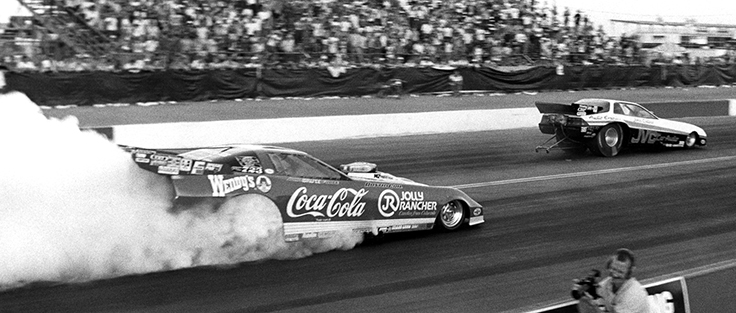
Speaking of fires, Firebird International Raceway got a national event as NHRA resurrected the NHRA Fallnationals name that had been dormant since 1980. It was the first time that an NHRA national event was conducted in Arizona since 1955, when the final rounds of the inaugural Nationals were completed in Perryville, just outside of Phoenix, after a rain-out in Great Bend, Kan. John Collins won Funny Car in his JVC Camaro over John Force, who smoked the tires in his Coca-Cola Corvette and suffered his fifth straight runner-up, and he and new crew chief Austin Coil would finish second four more times before Force got his first win.
::: 1986 :::
Stunningly, Don Prudhomme found himself without a sponsor and sat out the entire season, his first since the early 1960s. The once-unbeatable “Snake” had not won a national event since the 1982 Summernationals. As a lifelong fan of the man, I had looked forward to interviewing him win after win, but he hit a real drought not long after I joined NHRA. Was I a jinx?
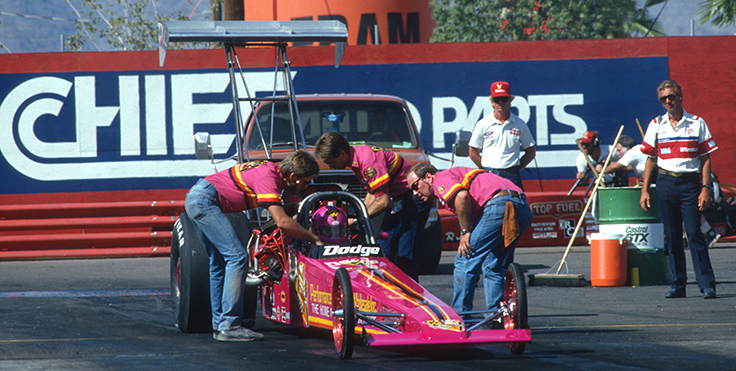
Just as one superstar went to the sidelines, another came off long-term IR as Shirley Muldowney returned to the sport, making her first runs at the preseason event at Firebird International Raceway. I remember all of us swarming her pit area to watch her initial fireup. There’s some great video of this floating around, and you can see Muldowney wink at someone — I’m assuming it was her son, John — when the Hemi found fire.
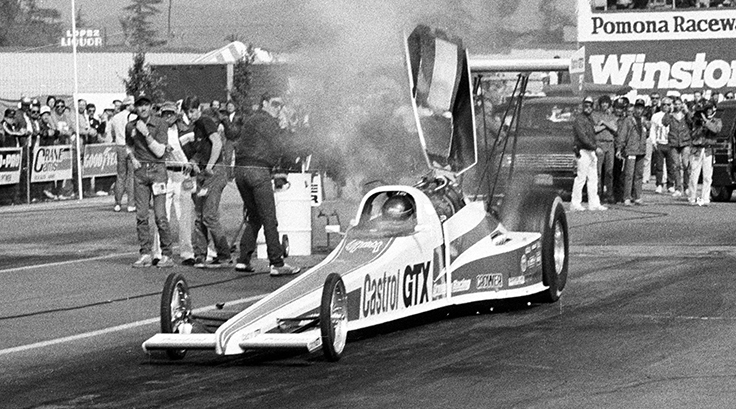
Gary Ormsby unveiled his super-swoopy and innovative Castrol GTX streamliner, and the car’s debut was a bang ... in the worst way. An ignition short caused by the engine-cloaking body touching the magnetos led to a huge blower explosion in the water box on its first pass. The team ran the rest of the event sans the bodywork.
Garlits introduced Swamp Rat XXX, his groundbreaking streamlined Top Fuel dragster designed with a slick, aerodynamic nose and a cockpit canopy, at the Gatornationals. The radical machine shattered the 270-mph barrier in the semifinals, clocking an eye-popping 272.56 mph, and went on to win the event and, ultimately, the world championship again.
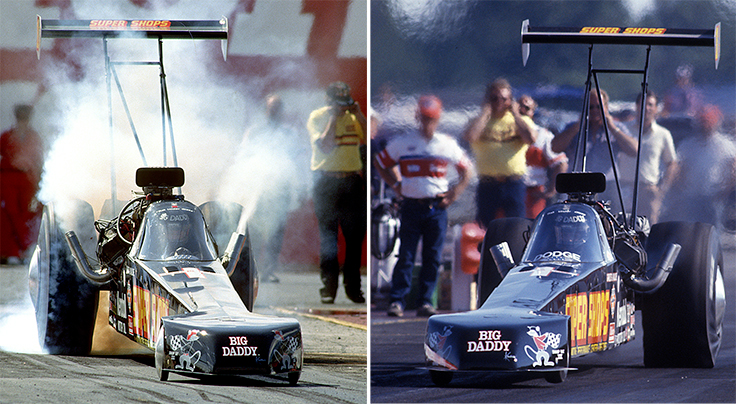
The only hitch in Garlits' weekend was the front "tire" setup, which featured generator belts wrapped around aluminum discs. The belts repeatedly exited the "wheels" at the top end of every pass when "Big" dumped the laundry, and they were replaced at the next race by small aircraft tires (above right), which became all the rage for a few years before the teams realized that what they gained in aero advantage was lost on staging rollout.
(I explored this 1980s streamliner rage in a Dragster Insider column here, packed with all kinds of details and interviews)
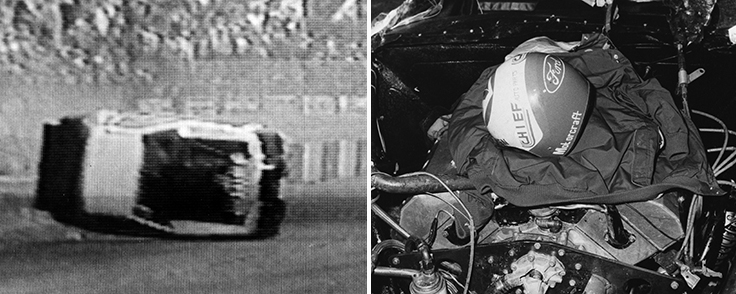
At the next race, after a winning semifinal run at the Southern Nationals in Atlanta, Pro Stock icon Bob Glidden’s parachutes were snatched by a sudden gust of wind, and his Thunderbird barrel-rolled six times down the track at more than 180 mph before finally coming to rest.
What I remember most about that event is hearing his wife, Etta, scream on the starting line and Buster Couch consoling her. Remarkably, Glidden emerged uninjured and immediately covered the exposed intake manifold with his fire jacket to shield his horsepower secrets from prying eyes.
The other thing I remember is that the day had run a bit long, and with the long cleanup, we had to leave to catch our late flight home (this was when ND was a weekly with super-tight deadlines). I remember asking to go to the Diamond P TV truck to see a replay of Glidden’s wreck to count the rolls accurately for our coverage. The race finished the next day with former NFL quarterback Dan Pastorini emerging as the surprise winner in Top Fuel.
Garlits and Ormsby had what is the only final-round battle between two streamliners in NHRA history at the Cajun Nationals, with “Big” taking the win. The event also was the first of 75 victories for future Top Alcohol Funny Car legend Pat Austin, who beat Dal Denton (on whose car I was crewing for an ND story) in the final round.
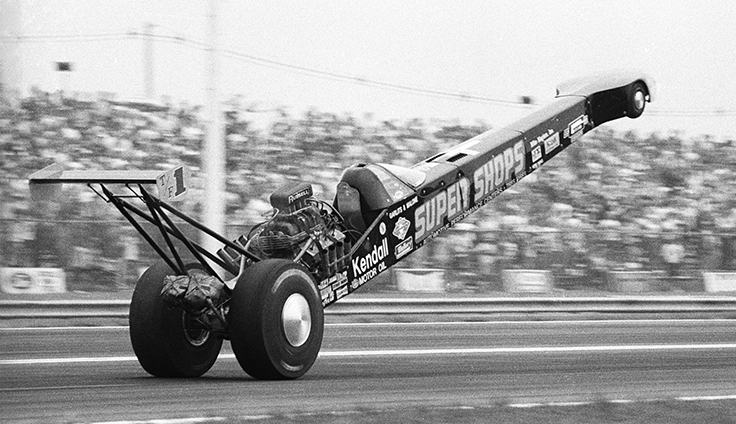
A few races later, at the Summernationals in Englishtown, Garlits experienced one of the most iconic blowover wheelstands in Top Fuel history. I was standing with NHRA Vice President Carl Olson at the short chute area, and we watched as Swamp Rat XXX launched with the wheels up and then kept going up, up, and away, rotated almost fully backward, and pirouetted before landing back on its wheels headed back up track still under slight power. I remember distinctly Olson getting on his radio yelling, “Heads up, starting line … here he comes.”
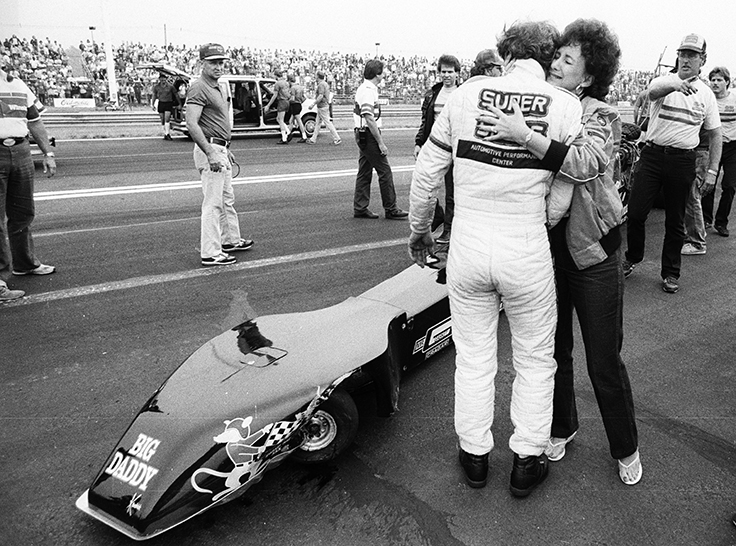
Garlits got it stopped easily and was swarmed by the Safety Safari and fellow racers. I remember Joan Gwynn, Darrell’s mom, hugging “Big,” and I remember Connie Kalitta chiding him, saying, “You know that [throttle pedal] works both ways,” angry at Garlits for apparently not lifting off the gas. As we came to understand in the rash of blowovers that followed, lifting wouldn’t save a Top Fueler once the air got under it.
Garlits’ wonderfully self-deprecating response after Steve Evans asked if he could repair the car was classic: “Even I’m not that crazy, Steve.” Here's a link to an interview we did with Garlits right after.
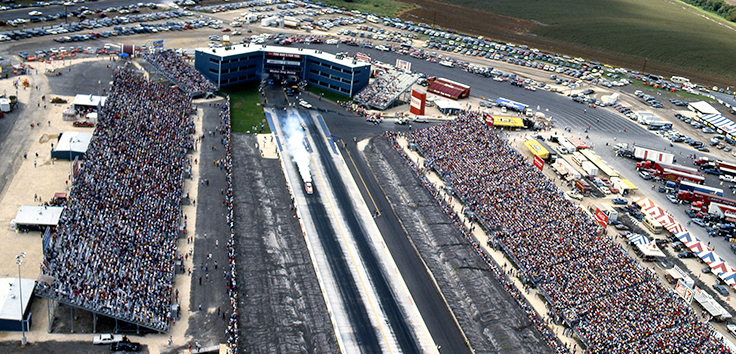
Texas Motorplex opened later that summer — ushering in the stadium-style raceplants invoked years earlier by NHRA President Dallas Gardner — and hosted its first national event, where Glidden became the first NHRA driver to reach 50 national event wins. The all-concrete track became the standard for all others, and the performances that emanated from the ‘Plex were often otherworldly.
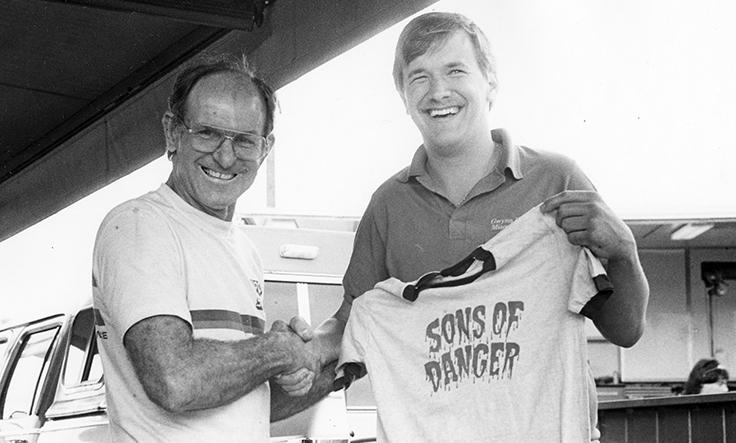
Darrell Gwynn, who had won the Winternationals, began to emerge as a real force in Top Fuel, challenging fellow Floridian Don Garlits, who quickly dubbed him “the Wolf,” a nickname that, thankfully, never stuck. Garlits fended him off in Indy and again in the final at the Motorplex.
Kenny Bernstein clinched his second of what would be a Prudhomme-matching four straight Funny Car championships, then made even bigger headlines in the offseason, locking down crew chief “Million-Dollar Dale” Armstrong with a five-year, $1.5-million contract, starting the soaring escalation of crew chief salaries that continues to this day.
::: 1987 :::
Don Garlits scored his first Winternationals victory since 1975, defeating Joe Amato in the Top Fuel final. Kenny Bernstein paced the quickest Funny Car field ever with a national record 5.48 and ran a 5.49 in the final to beat upstart Aussie Graeme Cowin in drag racing’s version of the America’s Cup sailing battle that was raging at the same time. Cowin’s team had been flying the Australian flag with each victorious run down the return road, and someone found a U.S. flag for Bernstein's crew just before the final round, which they waved gloriously after their victory to the cheers of the crowd.
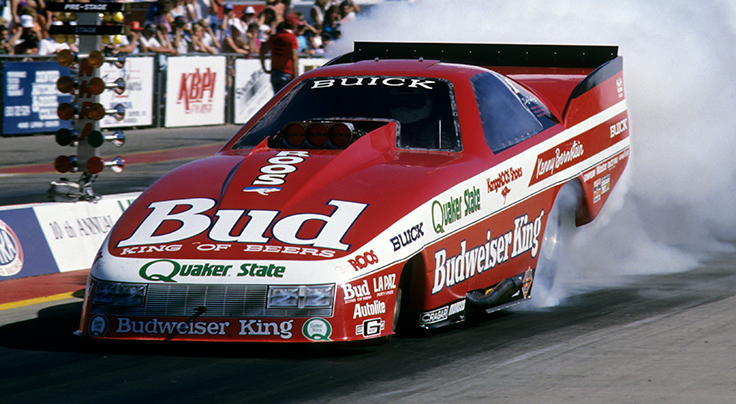
Dale Armstrong began earning that million-dollar paycheck right away as Bernstein’s Bud King body that season was a wildly sculpted Buick LeSabre, a rules abomination that fit within the letter of the rules but not the spirit (and was quickly dubbed "the Batmobile" or even "the dump truck" for its wildly extended back deck). It was ungodly fast, and NHRA eventually tightened the rules for future seasons to remove further rule-skirting.
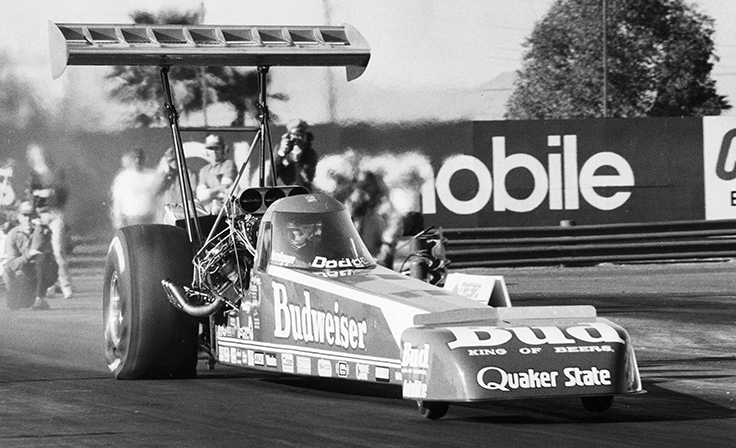
Even though Darrell Gwynn’s conventional car had been the performance star of 1986 — running the five quickest e.t.s (best of 5.26) and four fastest speeds (best of 278.55 mph) — the Gwynn team didn’t win the championship and decided in 1987 to follow Garlits’ lead by debuting a covered-nose, canopied dragster as part of a new Budweiser alliance with Bernstein. To accommodate the longstanding pre-run handshake between Darrell and his father, Jerry, a little hatch was added to the side of the cockpit — at ND we jokingly called it “the Daddy Door” — so that Jerry could reach in and shake his son’s hand.
The car was ungodly heavy, tipping the scales at 2,100 pounds on a 1,800-pound minimum, and the team quickly ditched the canopy and the nose but kept the small front tires. At the next race, in Gainesville, Gwynn qualified No. 1 and reset the national record to 5.22 and was runner-up. He ran 5.17 two weeks later at the Allstars at Texas Motorplex and reset the national record to 5.20 in Atlanta.
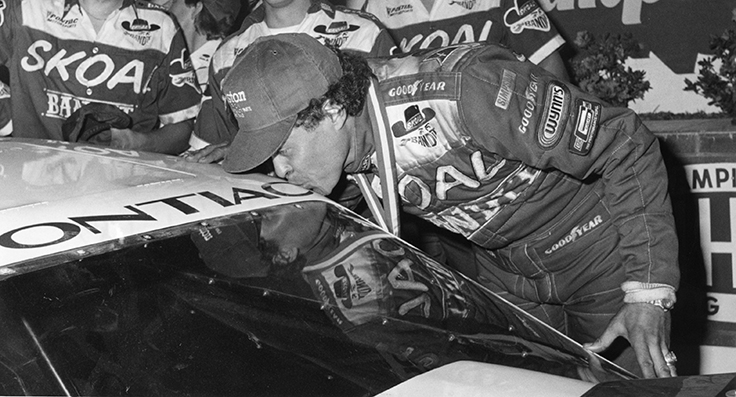
After going winless since 1982 and sitting out 1986 due to a lack of sponsorship, Don Prudhomme let everyone know that "the Snake" was back as he powered his new Skoal Bandit Pontiac through the 1987 Gatornationals field, breaking a 55-race victory drought, the longest of his career to that point. His most recent victory, at the 1982 Summernationals, had been the 34th of his great career, but during his five-year drought, he watched Bob Glidden zoom ahead of him by a good margin to become the sport's new all-time winningest driver. He set the world back on its axis in Gainesville with a strong but not dominating performance. I wrote a column in ND saluting his victory and got a nice note back from him saying, “Thanks, man … let’s do it again.”
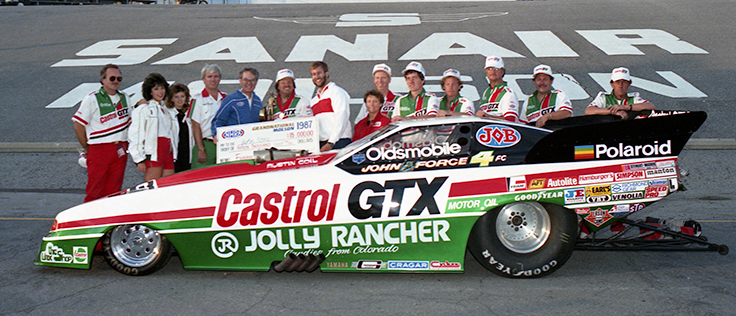
Speaking of breaking droughts, after a record nine runner-ups and a decade on the national event tour, John Force finally captured his first career Funny Car victory at the Le Grandnational Molson in Quebec, defeating seasoned veteran Ed “the Ace” McCulloch in the final. With crew chief Austin Coil by his side throughout the 1990s and 2000s, Force went on to amass an astonishing 157 wins and 16 Funny Car world championships.
Don Garlits crashed again, backflipping Swamp Rat 31 in Spokane, Wash., and (again) talked about retiring from driving. He sat out for a while, did some TV commentating, restored some older Swamp Rats, then returned for yet another encore a few years later.
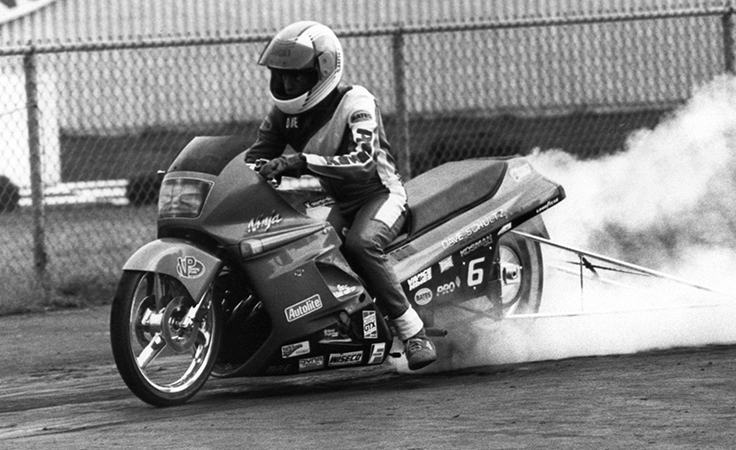
NHRA officially introduced Pro Stock Motorcycle as a world championship category this year, giving motorcycle drag racers a consistent, prestigious platform to compete at the sport’s highest level. Although motorcycles had long been a part of NHRA events in exhibition and sporadic competition formats, this marked the first time the class was fully sanctioned with a points system and national titles on the line. The inaugural season featured a mix of factory-backed teams and independent riders, including early stars like eventual champ Dave Schultz, Terry Vance, and John Myers.
So, as you can see from the sheer number of monumental things that happened in these five years, they were certainly formative ones for the sport and for me. I enjoyed the hell out of them, including participatory journalism like accompanying Jim DePasse to the 1984 Gatornationals, my unforgettable rides in Frank and Linda Mazi’s blown Opel, and, of course, becoming the editor of ND in 1986.
I opened the column with some great quotes about the first five years, so I’ll close with a couple of more that resonate with me.
- "The first years of any job teach you more than any textbook ever could."
- "In the first five years, you're not just building a résumé — you're building your reputation."
- "Five years in, and you're no longer new — you're necessary."
- "You arrive to learn; you stay to lead."
And I’m especially reminded of this quote, often attributed to Mark Twain: “The two most important days in your life are the day you are born and the day you find out why.” I certainly found out the “why” in those first five years.
Phil Burgess can be reached at pburgess@nhra.com
Hundreds of more articles like this can be found in the DRAGSTER INSIDER COLUMN ARCHIVE
Or try the Random Dragster Insider story generator