

-
Behind the Scenes with the winners of the 2026 NAPA Auto Parts Midwest Nationals
-
Weekend Rewind: 2026 NAPA Auto Parts NHRA Midwest Nationals
-
Saturday in St. Louis: NAPA Auto Parts NHRA Midwest Nationals photo gallery
-
Could St. Louis bring out the best in Erica Enders once again?
-
Cameron Ferre: Still chasing Top Fuel greatness, just on his own terms
-
-
Ron Capps thinking big at NAPA Auto Parts NHRA Midwest Nationals
-
Top Fuel’s Shawn Langdon looking for fourth straight win of 2026
-
Behind the Scenes with the winners of the 2026 NHRA Nationals at The Rock
-
Weekend Rewind: The inaugural NHRA Nationals at the Rock
-
Five Things We Learned in Rockingham
-
New venues like Rockingham bring excitement for old pro Ron Capps
-
That was then, this is now: The Winston Invitational at Rockingham
-
After a near-miss in Michigan, Ingwersen and crew are more inspired than ever
-
Jordan Vandergriff relishes first opportunity to race at Rockingham Dragway
-
Behind the Scenes with the winners of the 2026 Dodge NHRA Great Lakes Nationals
- ad
-
Weekend Rewind: 2026 Dodge NHRA Great Lakes Nationals
-
Five things we learned from the Dodge NHRA Great Lakes Nationals presented by Mopar
-
Vandergriff and crew took aim at No. 1 in challenging Michigan conditions
-
Friday Photo Gallery- NHRA makes a monumental return to Michigan
-
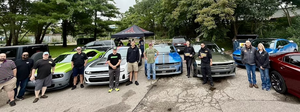
Inaugural Dodge and NHRA Tour de Michigan launches historic race weekend
-
Reigning world champ Dallas Glenn gears up for first Countdown race
-
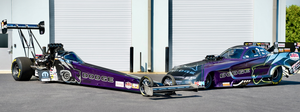
Stewart, Hagan, Pruett reveal new Dodge Charger Super Bee Purple Haze liveries
-
Behind the Scenes with the winners of the 2026 Cornwell Tools NHRA U.S. Nationals
-
Weekend Rewind: 2026 Cornwell Quality Tools NHRA U.S. Nationals
-
Malcolm Phillips makes his Pro Stock Motorcycle return at Indy
- ad
-
No canopy, no problem for Justin Ashley and his crew chiefs
-
Prock Indy three-peat would make U.S. Nationals Funny Car history
-
Howey returns to Indy with his eyes on a Top 10 berth
-
Nataas looks to add to previous Indy success story
-
Outlaw Street's Paige Coughlin looks to add a Wally to extensive family collection
More Top Fuel history awaits Tony Schumacher with 900th round win ahead
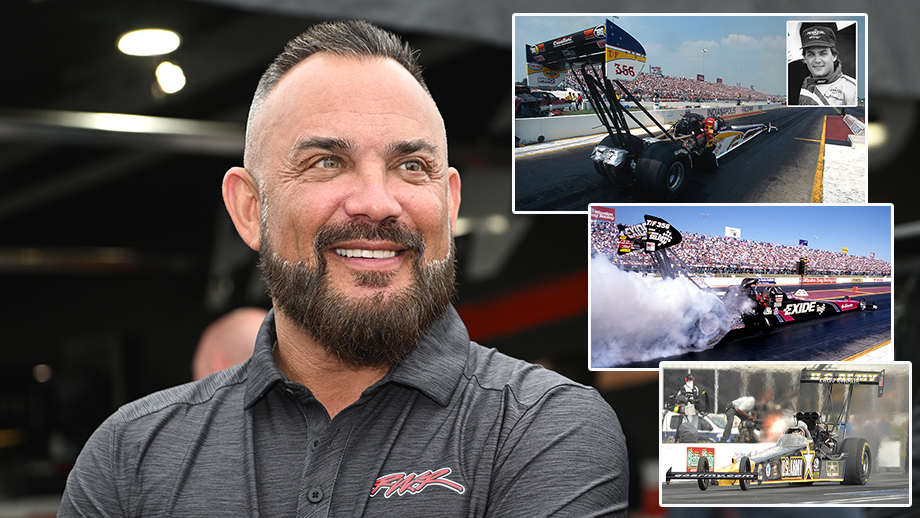
Tony Schumacher already owns multiple Top Fuel class records that will probably never be broken, but another significant milestone in his hall of fame career is in reach this weekend at the Texas NHRA FallNationals.
If Schumacher, the most successful Top Fuel driver in NHRA history with 10 world championships and 88 national event wins, can reach the Top Fuel final — as he’s done a class-record 161 times in his 28-year career — he’ll become just the fourth driver in NHRA history, and the first in Top Fuel, to record 1,000 round wins. He's sitting on 897 right now.
Only Funny Car legend John Force (1,459), six-time Pro stock world champ Greg Anderson (1,018), and three-time Funny Car world champ Ron Capps (936) have previously passed the 900-win threshold, a mark that Schumacher would have eclipsed a few seasons ago if not for having to sit out the entire 2021 campaign due to funding issues.
Only longtime rival Doug Kalitta, with 833 round wins entering this event, is in the same universe as Schumacher. Four-time and reigning Top Fuel champ Antron Brown will probably be the next to reach 900 rounds wins as he’s currently sitting on 871, but “only” 650 of those have come since he switched from Pro Stock Motorcycle to Top Fuel in 2008.
In his prime, Schumacher was a round-winning machine, compiling 441 (nearly half of his total) in a nine-season span, 2004-12, during which time he also won six of his 10 championships.
Schumacher’s single greatest season came in 2008 when he amassed a class-record 76 round wins (against just nine losses) en route to 15 event wins and 18 final-round appearances, also both single-season class records. He also had 60 round wins in 2004 and 56 in 2005, and in 2006 set the class record for most No. 1 qualifiers in a season at 13.
If this were a drinking game where you took a shot every time I wrote "class record," you'd be under the table by now.
The rise of Tony Schumacher
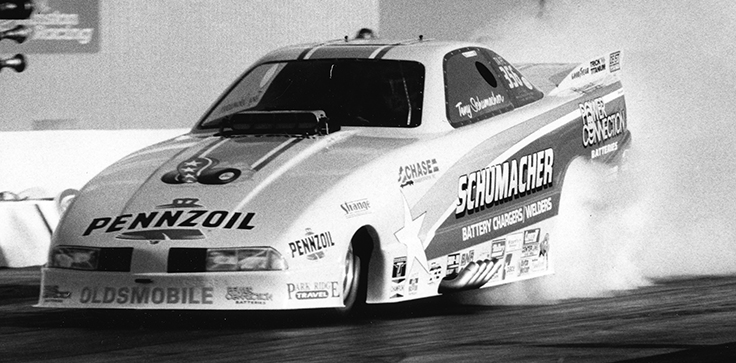
It all began humbly enough for the second-generation nitro driver, whose late father, Don, was a pioneer of multi-car teams back in the 1970s. Tony drove jets cars and in 1985 wheeled an Alcohol Funny Car sponsored by his father’s company, Schumacher Electric. After blowing the body off of the Funny Car at a Division 3 points meet in Martin, Mich., Tony called NHRA’s Steve Gobbs looking for advice on his next steps.
Gibbs told him that the Colorado-based Peek brothers — Greg and Mike — were replacing Rance McDaniel in the seat of their dragster and looking for a new driver. Gary Scelzi, also ready to make his climb out of the Top Alcohol ranks, already had his hat in the ring. They asked Schumacher to send them a resumé, but he instead flew to the Peek’s Lakewood, Colo., base, licensed in the car at Bandimere Speedway, and got the job.
Schumacher made his debut at, of all places the prestigious U.S. Nationals, a race that he would later dominate like no other.
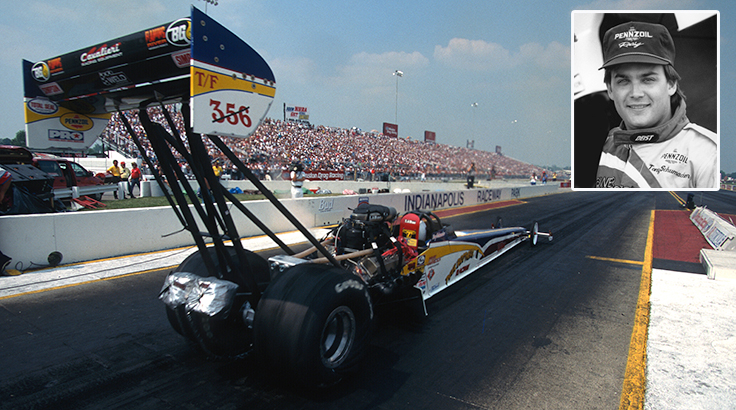
Schumacher and the Peeks squeaked into the field in the No. 16 spot with a 4.900 pass and probably would have been easy first-round fodder for points leader and No. 1 qualifier Blaine Johnson, but Johnson was killed in a top-end accident on his No. 1-qualifying run. With the other lane empty, Schumacher took what looked like a respectful 21-second idle down the track to claim the win.
Nearly 30 years later, Schumacher dispels the myth of that run.
“I had asked Mike and Greg 'What should we do?' and they said, ‘Blaine deserves a full run,’ but when I went to pull the fuel pumps on, they would not go on. I mean , when in the world do they not pull on? I was already fully teared up in my helmet anyway, so I had to just idle down the track and got a standing ovation and everyone thought we did that on purpose, but it all worked out just amazing because it wouldn't have been a safe ride anyway. And then, of course, we all know what happened next for Gary Scezli. It was all meant to be.
(Scelzi was hired by the Johnson family to take Blaine’s seat and won the championship the next season. Had he been driving for the Peeks instead of Schumacher, would that still have happened? Who knows?)
Schumacher went on to upset fellow future world champion and nemesis Larry Dixon in round two at Indy and beat Mike Dunn in a tire-smoking semifinals before Cory McClenathan ended his Cinderfella run in the final round.
Schumacher won just one more round in the other three races he ran that year, but reached two more finals in 1997 with the Peeks before the senior Schumacher saw his son’s greatness and put him into his own Top Fueler starting in 1998.
A champion is born
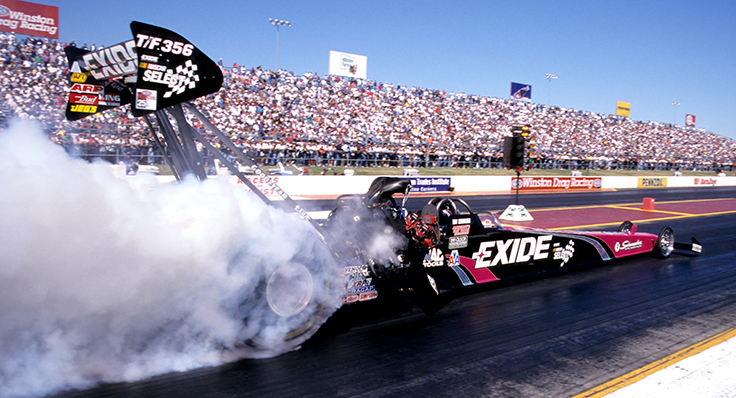
“My dad had been flying around on a plane with Art Hawkins from Exide, and they already had Jeff Burton driving the Exide car in NASCAR, so my dad asked them if they’d like to get into drag racing, and they put a deal together. We hired Bob Brandt as our crew chief and thrashed the car together. They won just seven rounds all year, three of which came in yet another runner-up, this one at the fall Houston event, and they started 1999 with veteran Dan Olson twisting the wrenches.
That season, Schumacher won his first event, at the Texas Motorplex, and went on to win the world championship, his first of 10.
The Army and beyond
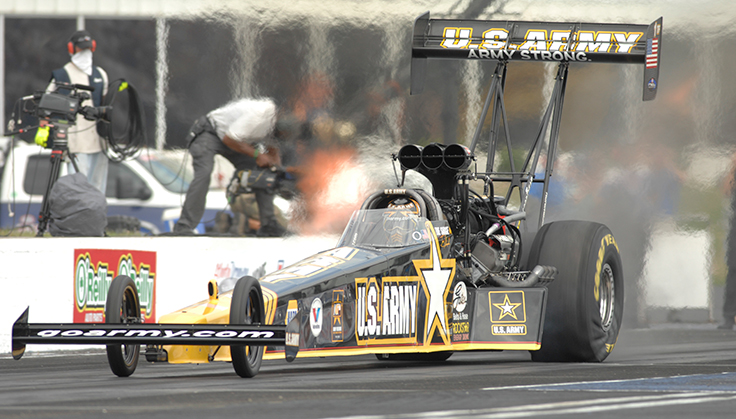
Schumacher was recruited for the Army sponsorship that would define his career in 2000 but wouldn’t win another championship until 2004, which was the start of six straight No. 1 finishes.
“Yeah, we made a lot of good runs, had a lot of good teams, a lot of good people, and good combinations. When Alan [Johnson, crew chief] was there was a lot of stuff that happened. All those wins, all the Indy wins, ‘The Run,’ so many great things happened to us in those years. I think my dad did a hell of a job putting kick-ass crew chiefs in, making sure that people could get paid so we can hire good crews. And then, if you do a good job driving the results come.”
The results showed 10 world championships and 83 wins under the Army as Schumacher marched his way into the history books.
So, what makes a champion?
Schumacher always liked to refer to himself as “The Machine,” just always doing the same thing, but that’s not enough to win a championship, right?
“[Track specialist] Lanny Miglizzi used to say to me, ‘Just be a machine,’ and to me that just meant to flip the light switch on. Do the same thing. You know, when you turn a light switch on, the light goes on. Do that. Don't overthink it. Just drive the car, so it’s easier for a crew chief to make very good decisions if I’m doing the same thing.
“I can't take the credit for it all. If I do a good job driving the race car, I think it makes the crew chief grow a set that he couldn't have if you didn't, and I think that's super important. He’s just going to be able to do his job because he's not afraid of it having the wheels not on the ground because I got the car loose. We can throw whatever is the best thing that's gonna make a car run, because he can trust that I’ll do my job. I think that matters.
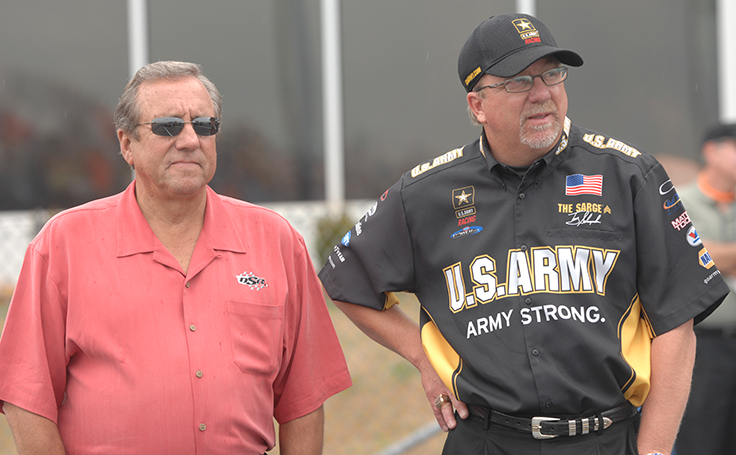
“Communication really makes it work. If you talk before a run and go, ‘This is a big round. Here's what we need to do. There's a spot here you need to avoid before.’ You sit down and you evaluate how to make something successful, and you've got to win most of the rounds you're supposed to win, and then win a few ones that are just ugly, and that's because you've got to win a lot of rounds to win a lot of rounds to be a champion.
“The other thing is, you can be a good driver and not have the stomach for the end of the season. The end is brutal. I'm happy to say that some people I thought couldn't do it did a hell of a job at the end. I think some people learned that you can get better with pressure. I think I'm that guy. I think there's a number of people out there that can get better, and then there's people who are going to throw up in their helmet.”
Success begets more teams
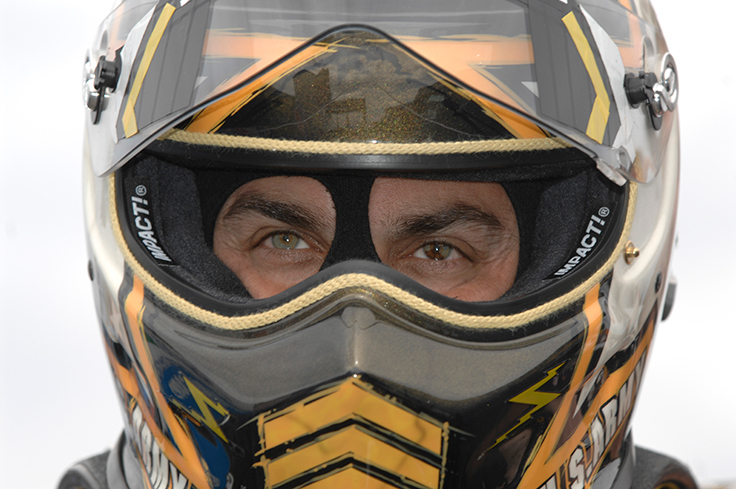
"We built a long-term deal with the Army," he said. "I showed up weeks before races, doing endless amounts of speeches, endless amounts of stuff to keep those deals. A lot of work went into making other teams come about.
Schumacher’s success helped supercharge the growth of what became Don Schumacher Racing’s armada of cars.
“Originally, we had Mac Tools on my car, but then we switched to Matco, and eventually they grew to where they wanted another car, which puts another driver in the car — Whit Bazemore and then Antron [Brown] — and it started to grow our team.
"Then we had to put a second car out there because we needed to keep Exide on for a short while, so we put Melanie [Troxel] in that car and just kept growing. Other than us and Force, there weren’t many other team cars, and we proved how it takes a team to make work. That's why we came over to Rick [Ware]. He looked back and saw that the team cars tend to win. And I agree with that. You get to share info. You get to race like a team.”
Overcoming the lean years
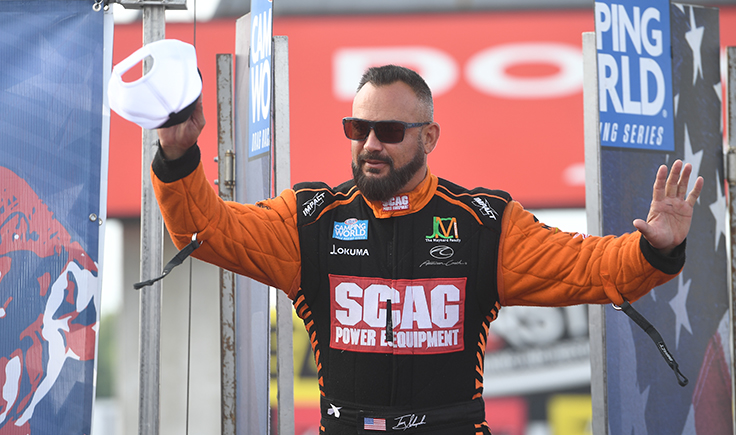
Schumacher struggled to remain funded after the Army deal ended and even sat out the 2021 season after losing a sponsorship deal at the last minute. He got up with Joe Maynard, and they got the Scag deal, which they then lost, much to their chagrin.
“There was a while there where we were pretty easy to beat,” he conceded. “Really, if your car started, you had a good chance to beat us. For whatever reason, it just seemed like someone had stuck a pin in a voodoo doll. But if we both smoke the tires, I'm gonna give you a battle. If you give me a race car, I'm gonna give you a battle.”
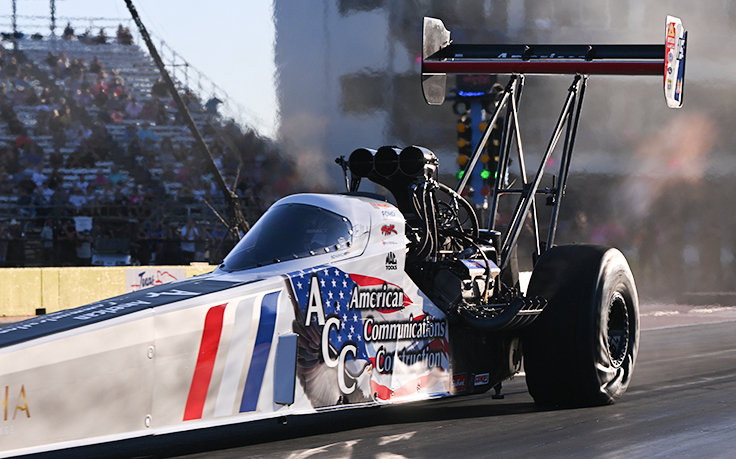
He bounced back that year with two wins and an eighth-place finish, then sat out the start of this year before hooking up with Rick Ware Racing and bringing aboard well-regarded tuner Rob Flynn to guide a car now sponsored by American Communications Construction owner David McBride that debuted late in the season.
“It was just about putting the right people together," siad Schumacher. "Rob Flynn was not initially available, so we sat patiently and waited. The right guy is available, but now we have him, and we will do just fine. Our plan is to spend whatever we've got to spend.; To have the right parts, the right pieces, the right crew, the right guys, and then we'll do our job. Rob Flynn didn't come over here because he didn't think we could win the championship.
“David will give us whatever we need not to win a championship, but to be able to contend so that if you don't win is there's no excuse. And then that's the key. Now we need to we need a backup car. We need parts and pieces. We're filling this. All the stuff we’ve bought is nice, top of the line, great stuff. Now we need to work on a tune-up.”
The Big 900
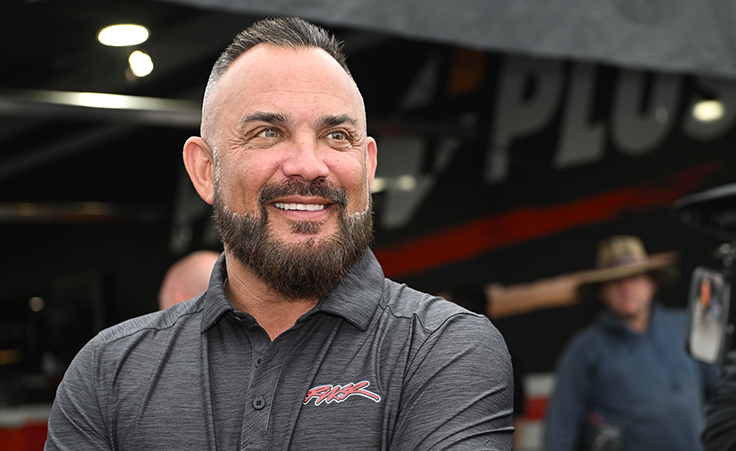
“I don't usually pay attention to the numbers, but 900 is a pretty good one,” he said when informed of the upcoming milestone. “If there's a place to do it, this would be it. I love this place. I love the Meyer family. I love the way he built this place. This would be great. David McBride is here with his family, so if there's ever been a want -- because I'm not usually the kind of guy that's like, 'Oh, you know what I want?" because I let things fall and play and not overthink it -- but this would be a really great place to have that.
Schumacher, who was recently inducted into the Motorsports Hall of Fame of America, had his own number to bounce back with
“
“I’m in the Hall of Fame, but when you look back, everything I’ve accomplished, I’ve done in a little over five hours under power behind the wheel,” he noted. “Maybe 5,000 or so runs at three or four seconds of time still doesn’t add up to what a NASCAR racer does in two races.
“Maybe I’m just overpaid,” he said with a grin,” but I’ve loved every second of it. More than just being a champion or a racer, I am an entertainer. We all are. We’ve got to remember that, first of all, if everyone leaves here having a great time, we’ve done our job. I've had fans come to me and go, ‘I paid whatever 60 or 80, bucks to come in here. I feel like I owe more money because that was the best race I ever saw.’
“When they leave, they ought to say that’s the best money I’ve ever spent, because that means we’re doing it right and filling the stands because they're seeing what they paid for.”